
 TIMEBUCKS
Low minimum
payout of just
$3 — start
earning today!
If you’re new to trading and just discovered Deriv, one of the first things that will confuse you is the number of accounts on offer.
Which Deriv account is best for beginners? The short answer is the Demo Account first, then the Standard (MT5) Account — but understanding why will save you a lot of costly trial and error.

This guide breaks down every Deriv account type in plain English — no jargon, no overwhelm.
Whether you’re in Nairobi deciding between the Synthetic and Financial account, or simply trying to figure out demo vs real, this article has you covered.
Best Deriv Account for Beginners
Start with the free Demo Account — then open a Standard MT5 Account when you’re ready to trade real money. The Standard Account gives you access to both synthetic indices (like Volatility 75) and forex from one place, requires only a $5 minimum deposit, and is the most flexible option for beginners and intermediate traders alike.
Overview: How Deriv Accounts Are Structured
Before diving into each type, it helps to understand how Deriv organises its accounts. There are two layers:
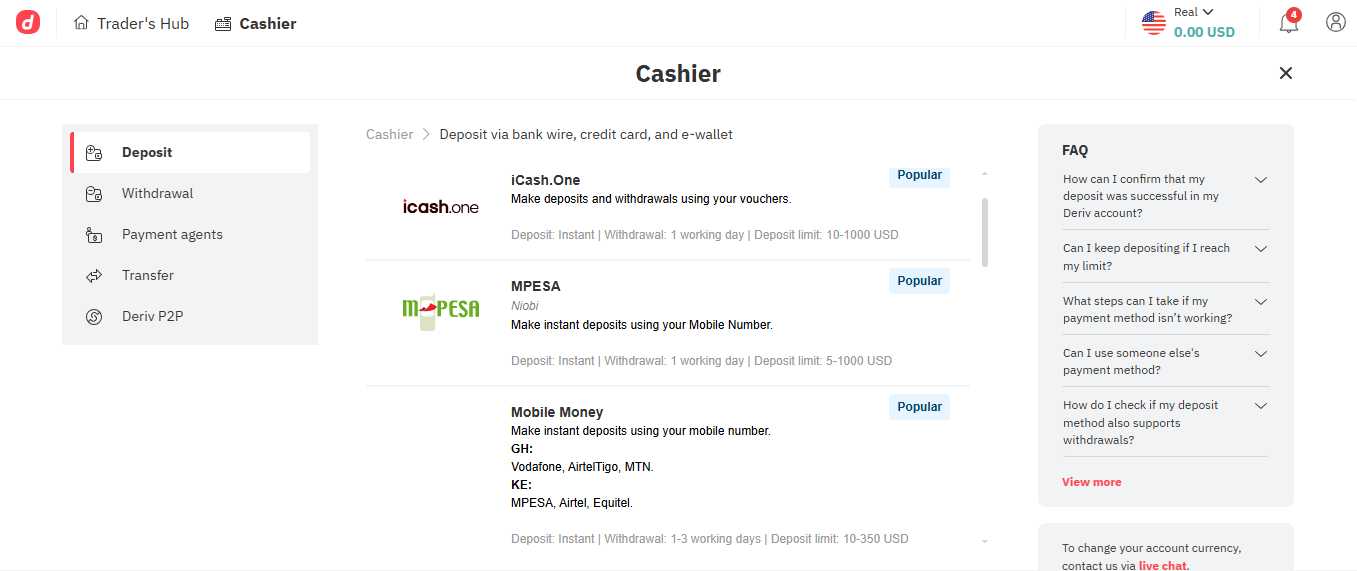
Layer 1 — Your Main Deriv Account: This is your wallet. You sign up, verify your identity, and this is where your funds sit. You can deposit via M-Pesa here.
Layer 2 — Your Trading Account: From your main account, you create specific trading accounts on platforms like MT5. Each trading account serves a different purpose. You transfer funds from your main wallet into whichever trading account you want to use.
Think of your Deriv account as a bank account, and your MT5 trading accounts as different “pockets” you allocate money to for different strategies.
All Deriv Account Types Explained
1. Demo Account
Best for: Absolute beginners. Anyone who hasn’t tried Deriv yet.
The Demo Account is free, requires no deposit, and comes loaded with virtual funds (usually $10,000). It mirrors the real platform exactly — same prices, same instruments, same tools.
Key facts:
- Free with no time limit (main account demo doesn’t expire)
- Available on all Deriv platforms: MT5, Deriv Trader, SmartTrader, Deriv X
- No real money at risk
- MT5 demo accounts deactivate after 30 days of inactivity, but can be re-created freely
Why beginners should always start here: You learn how the platform works, test your strategy, and understand how leverage and margin work — all without losing a single shilling. There is genuinely no good reason to deposit real money before spending time on the demo.
TIMEBUCKS
Low minimum
payout of just
$3 — start
earning today!
2. Standard Account (MT5 Standard / Derived Account)
Best for: Beginners moving to real trading, synthetic indices traders, multi-market traders.
This is the most popular account on Deriv and the one most Kenyan traders use. It was previously called the “Synthetic Indices Account” or “Derived Account” before being renamed Standard.

What you can trade:
- Synthetic indices (Volatility 10, 25, 50, 75, 100, Crash & Boom, Jump indices, Range Break)
- Forex (major, minor, and exotic pairs)
- Cryptocurrencies
- Basket indices (Deriv’s proprietary currency baskets)
- Derived FX indices
Key facts:
TIMEBUCKS
Low minimum
payout of just
$3 — start
earning today!
- Minimum deposit: $5
- Maximum leverage: up to 1:1000 (varies by instrument)
- Available 24/7 including weekends (for synthetic indices)
- No commission on most trades
- Accessible via MT5 desktop, web terminal, and mobile app
Why it’s best for beginners: Everything is in one account. You don’t need to decide between synthetic or forex at the start — you can try both and see what suits you. The low $5 minimum means you’re not risking much while you find your feet with real money.
3. Financial Account (MT5 Financial)
Best for: Traders who want to focus exclusively on real-world financial markets.
The Financial Account is designed for trading CFDs on real global markets. Unlike the Standard Account which includes synthetics, this one is purely focused on traditional financial instruments.
What you can trade:
- 170+ instruments including forex (standard and micro lots), stocks, stock indices, commodities, cryptocurrencies, and ETFs
- Major, minor, and exotic currency pairs
- Metals (gold, silver)
- Global stock indices (DAX, S&P 500, NASDAQ, etc.)
Key facts:
- Maximum leverage: up to 1:1000
- Variable spreads
- Supports micro-lot trading (0.01 lots) — good for precise risk management
- No synthetic indices on this account
When to use it: If you’re specifically focused on forex trading, stock indices, or commodities — and have no interest in synthetic indices — the Financial Account gives you tighter access to real market instruments. It’s better suited to traders who follow economic news and want to trade events like NFP, inflation data, and interest rate decisions.
4. Swap-Free Account (Islamic Account)
Best for: Muslim traders who cannot pay or receive interest (swap fees) for religious reasons. Also useful for anyone who regularly holds positions overnight.
A swap (or rollover) is a fee charged or credited when you keep a forex or CFD trade open past midnight. For some traders — especially those who hold positions for multiple days — these fees add up significantly.
The Swap-Free Account removes overnight swap charges. Instead, after a grace period, Deriv applies an administration fee per lot held.
Key facts:
- Available on MT5 (synthetics, forex, stocks, stock indices, cryptocurrencies, ETFs)
- Derived (synthetic) indices: admin fee kicks in after 5 days of holding
- Financial instruments: 15-day grace period before admin fee applies
- Available to traders in supported regions — primarily offered to Muslim traders but not exclusively
Important: The swap-free account is not automatically free of all costs. The administration fee replaces the swap fee, so compare costs if you’re a frequent overnight holder.
5. Financial STP Account (Zero Spread / Advanced)
Best for: Experienced, high-frequency traders and scalpers.
STP stands for Straight Through Processing — your orders go directly to liquidity providers with minimal broker intervention. This account type is Deriv’s “A-Book” model, meaning it’s 100% passed to the order book of liquidity providers.
Key facts:
- Ultra-tight spreads (some near zero on majors)
- Commission charged per trade instead of spread markup
- Leverage up to 1:100
- Best for forex pairs and cryptocurrencies
- Not recommended for beginners — the commission structure can be costly for small, frequent trades without a clear strategy
Read also: How Much Money Do Forex Traders Make in Kenya?
Synthetic Account vs Financial Account: What’s the Difference?
This is the question most Kenyan beginners ask, so let’s make it crystal clear.
| Feature | Standard (Synthetic) | Financial |
|---|---|---|
| Markets | Synthetic indices + forex + crypto | Forex, stocks, indices, commodities, ETFs |
| Trading hours | 24/7 including weekends | Weekdays (except crypto) |
| Market influence | Not affected by real-world news | Moves with real economic events |
| Price source | Algorithm (cryptographically secured) | Real market prices |
| Best for | 24/7 traders, beginners, strategy testing | News traders, forex specialists |
| Minimum deposit | $5 | $5 |
| Leverage | Up to 1:1000 | Up to 1:1000 |
The key distinction is this: Synthetic indices are Deriv’s own proprietary instruments — they are not real markets. Their prices are generated by a secure algorithm, meaning world events (elections, economic data, geopolitical crises) do not affect them. This makes them very popular with Kenyan traders who want to trade at any hour without worrying about news events catching them off guard.
The Financial Account trades real market instruments. When the US releases jobs data at 3:30 PM Nairobi time, your USD/KES or EUR/USD positions will move — potentially sharply.
For beginners: The Standard Account (with synthetic indices) is generally more forgiving because markets move predictably and are open 24/7. You can trade on Saturday morning or Sunday evening without worrying about gaps caused by weekend news.
Demo Account vs Real Account: Which Should You Start With?
This shouldn’t even be a question — always start with the demo account.
Here’s why this matters more than most people acknowledge:
On the demo account:
- You learn how leverage actually works in practice (not just theory)
- You discover your emotional reactions to losing trades — without real consequences
- You test whether your strategy actually works before betting money on it
- You get familiar with MT5’s order types, charts, and tools
- You find out which instruments suit your personality and schedule
On a real account:
- Your emotions are different — fear and greed affect your decisions in ways you cannot simulate
- Every mistake costs real money
- You discover real platform quirks (slippage, spreads at news time, etc.)
The recommended path for any Kenyan beginner:
- Weeks 1–4: Trade on demo only. Focus on one instrument. Track your trades in a journal.
- Month 2: If you’re consistently profitable on demo, open a real Standard Account with $5–$20.
- Month 3 onwards: Scale up gradually as you prove your strategy works.
One important note: Demo trading is psychologically easier than real trading because there’s nothing at stake. Don’t assume demo profits will automatically translate to real profits — they often don’t, at first. But demo trading is still essential preparation.
Which Deriv Account Should You Choose? (Decision Guide)
Use this to find the right account for your situation:
You are brand new to trading: → Start with the Demo Account. Period. Don’t deposit anything yet.
You’ve used the demo and want to start real trading: → Open a Standard MT5 Account ($5 minimum). It gives you access to both synthetic indices and forex from one account — ideal for testing what suits you.
You only want to trade forex, gold, stocks, and global indices: → Open a Financial MT5 Account. Better instrument selection for real-world markets with micro-lot support for precise position sizing.
You hold trades overnight and hate paying swap fees: → Open a Swap-Free Account. Especially relevant if you’re a Muslim trader or a position/swing trader.
You are an experienced scalper or use trading bots: → Consider the Financial STP / Zero Spread Account for tighter execution and direct market access.
You want to do everything from your phone with a simple interface: → Use Deriv Trader or Deriv X with a Standard Account. Both are mobile-friendly and beginner-accessible.
How to Open a Deriv Account: Step-by-Step
- Go to Deriv’s website and click “Create free account”
- Enter your email address and create a password
- Verify your email via the confirmation link sent to your inbox
- Complete your profile — name, date of birth, country (Kenya)
- Verify your identity — upload your National ID or passport
- From your Trader’s Hub dashboard, click to create an MT5 account
- Choose Standard Account (recommended for beginners)
- Fund via M-Pesa — minimum KES ~650 (approximately $5)
- Transfer funds from your main wallet to your MT5 account
- Download MT5 on your phone or use the web terminal to start trading
Pro Tip: Before funding, spend at least 2–4 weeks on the free demo account. Deriv’s demo is unlimited — there’s no pressure to rush into real trading.
Pros and Cons of Each Deriv Account Type
Standard Account
Pros: All-in-one access (synthetics + forex), 24/7 trading, beginner-friendly, $5 minimum Cons: Slightly wider spreads than Financial account on some forex pairs
Financial Account
Pros: Tighter spreads on real markets, micro-lot support, 170+ instruments Cons: No synthetic indices, markets closed on weekends, affected by real-world news events
Swap-Free Account
Pros: No overnight interest charges, good for position traders and Islamic traders Cons: Administration fee replaces swap after grace period, not available in all regions
Financial STP Account
Pros: Direct market access, zero/near-zero spreads, commission-based pricing Cons: Not beginner-friendly, commission costs accumulate with frequent small trades
Demo Account
Pros: Completely free, unlimited virtual funds, identical to real platform Cons: No real money emotions, MT5 demo deactivates after 30 days of inactivity
⚠️ Risks and Warnings for Beginners
Before you deposit, be clear about these realities:
High leverage is a double-edged sword. Deriv offers leverage of up to 1:1000 on some instruments. This means a $10 deposit can control a $10,000 position. Profits are amplified — but so are losses. A 1% move against you can wipe out your entire deposit. Always start with minimum position sizes.
Synthetic indices are not “easier” to trade. Many beginners assume that because synthetics aren’t tied to news events, they’re safer. They’re not. They still move rapidly and leverage losses can be just as swift as in forex.
The demo account doesn’t prepare you fully for real emotions. You will trade differently when real money is involved. Expect this, and start very small when switching to a live account.
Inactivity fees apply. If your account has no transactions for over 12 months, Deriv charges a dormant fee of up to $25 every 6 months. Keep this in mind if you plan to take breaks from trading.
Disclaimer: Trading forex, CFDs, and derivatives involves substantial risk of loss. Most retail traders lose money. This article is for educational purposes only and does not constitute financial or investment advice.
Expert Tips for Kenyan Beginners on Deriv
1. Pick one instrument and master it. Jumping between Volatility 75, EUR/USD, gold, and Boom/Crash simultaneously is a recipe for confusion. Start with one — ideally Volatility 10 or a major forex pair — and learn its behaviour thoroughly.
2. Trade small even on a real account. With a $5 minimum deposit, the temptation is to risk it all on one trade. Instead, trade 0.001 lots and treat every live trade as an extension of your demo learning.
3. Use the Traders’ Academy. Deriv has free educational content on their website. Courses, videos, and platform guides are available at no cost. Use them before you trade.
4. Withdraw regularly. This is practical discipline that many Kenyans overlook. When you make a profit, withdraw some of it to your M-Pesa. Don’t let your entire balance sit exposed in a trading account indefinitely.
5. Avoid “signal sellers.” A large number of social media accounts in Kenya claim to provide Deriv signals for a fee. Most are scams. No legitimate trader needs to sell signals to make money.
Ready to begin? Open your free Deriv demo account here — no deposit required.
FAQs: Best Deriv Account for Beginners
1. What is the best Deriv account for a complete beginner?
Start with the free Demo Account, then move to the Standard MT5 Account when ready for real trading. The Standard Account is the most versatile beginner option — it covers synthetic indices and forex from one place with just a $5 minimum deposit.
2. What is the difference between a Synthetic and Financial account on Deriv?
The Standard (Synthetic) Account lets you trade Deriv’s proprietary synthetic indices — algorithm-generated markets open 24/7 — plus forex. The Financial Account focuses on real-world instruments like forex, stocks, commodities, and global indices. Real accounts are affected by economic news; synthetic accounts are not.
3. Should I use a demo or real account first on Deriv?
Always start with the demo account. It’s free, has no time limit on the main Deriv account, and mirrors the real platform exactly. Only switch to a real account after you’re consistently applying a strategy and understand how leverage and margin work.
4. What is the minimum deposit for a Deriv account?
The minimum deposit on Deriv is $5 (approximately KES 650–700). This applies to the Standard, Financial, and Swap-Free accounts on MT5.
5. Can I trade synthetic indices and forex from the same account?
Yes. The Standard MT5 Account gives you access to both synthetic indices (Volatility 75, Crash & Boom, etc.) and forex pairs from one account.
6. What is a Swap-Free account on Deriv?
A Swap-Free (Islamic) account removes overnight swap/rollover charges. Instead of swap fees, a fixed administration fee is charged after a grace period. It’s designed for Muslim traders and anyone who regularly holds positions overnight.
7. Can I have multiple MT5 accounts on Deriv?
Yes. Deriv allows you to hold one of each account type — Standard, Financial, and Swap-Free — under one Deriv account. You can manage all from a single dashboard.
8. Is the Volatility 75 Index available for beginners?
The V75 is technically accessible on a Standard Account, but it is one of the most volatile synthetic indices available. Beginners are better served starting with Volatility 10 or Volatility 25, which have smaller price swings and are less likely to cause rapid losses.
9. How do I deposit to my Deriv MT5 account using M-Pesa?
Deposit to your main Deriv wallet via M-Pesa first (minimum ~$5), then transfer funds internally from your Deriv wallet to your MT5 account. Transfers between your Deriv wallet and MT5 are instant and fee-free.
10. What platforms can beginners use on Deriv besides MT5?
Beginners can also use Deriv Trader (simple web-based platform for options and multipliers), SmartTrader (browser-based binary options, very beginner-friendly), and Deriv X (mobile-first CFD platform). All have free demo versions.
Conclusion
Deriv has done a good job making its account structure accessible — once you understand what each account is for, the choices become much clearer. For 99% of Kenyan beginners, the path is straightforward: start on the demo, learn the platform, then open a Standard MT5 Account with a small real-money deposit when you’re ready.
Don’t rush into the Financial STP or Zero Spread accounts before you have experience. Those are built for traders who already know what they’re doing. Master the basics first.
Open your free Deriv account and start with the demo today →
Read also:
- How to Start Trading With No Experience
- Who Owns Deriv Broker?
- How to Trade on Deriv for Beginners
- Is Deriv Safe or Risky?
TIMEBUCKS
Low minimum
payout of just
$3 — start
earning today!