
 TIMEBUCKS
Low minimum
payout of just
$3 — start
earning today!
“Can you make money on Deriv?” is probably the most searched question by anyone considering the platform — and it deserves a completely honest answer, not a hyped-up sales pitch.
The short answer is yes, you can make money on Deriv. But most people don’t — at least not at first. The platform is real, the payouts are real, and there are genuine traders across Kenya and the world making consistent income from it.

But there are far more people who deposit money, trade emotionally without a plan, and lose it within days or weeks.
This guide gives you the full picture: who actually makes money trading, what realistic income looks like, the brutal truth about success rates, and the myths that keep most beginners from ever becoming profitable.
Can You Make Money on Deriv?
Yes — Deriv is a legitimate platform where real profits are possible. However, the majority of retail traders lose money due to poor risk management, lack of strategy, and emotional decision-making. Making consistent income from Deriv requires months of learning, disciplined practice, and realistic expectations about what trading income actually looks like.
How Traders Actually Earn Money on Deriv
Before asking whether you can make money, it helps to understand exactly how money is made on a trading platform in the first place.
When you trade on Deriv, you are speculating on price movements. If you predict correctly — and exit at the right time — you make a profit. If you predict incorrectly, you lose the amount you risked on that trade.
There are several ways traders generate income on Deriv specifically:
Forex trading — buying and selling currency pairs like EUR/USD or USD/KES. You profit when the currency you bought rises in value against the one you sold.
Synthetic indices trading — trading computer-generated markets like Volatility 75 or Boom/Crash indices. Profits come from correctly predicting short-term price direction.
Options trading — on DTrader, you can trade rise/fall, higher/lower, and other contract types where your payout is determined by where price ends up at expiry.
CFD trading — Contracts for Difference on MT5, allowing you to trade forex, commodities, and indices with leverage, profiting from price movement without owning the underlying asset.
In all of these, the profit mechanism is the same: buy low, sell high — or sell high, buy low. The challenge is doing this consistently enough to come out ahead after losses, spreads, and commissions.
TIMEBUCKS
Low minimum
payout of just
$3 — start
earning today!
Realistic Trading Income: What the Numbers Actually Look Like
This is where most people’s expectations need a serious reality check. Social media is flooded with traders showing KES 50,000 daily profits on their screens. Here’s what’s actually realistic.
What Professional Traders Target
Experienced, professional forex and derivatives traders typically aim for 3–10% monthly returns on their trading capital. That might sound underwhelming — until you do the math:

| Account Size | Monthly Return (5%) | Annual Return |
|---|---|---|
| $500 (KES 65,000) | $25 (KES 3,250) | $300 (KES 39,000) |
| $1,000 (KES 130,000) | $50 (KES 6,500) | $600 (KES 78,000) |
| $5,000 (KES 650,000) | $250 (KES 32,500) | $3,000 (KES 390,000) |
| $10,000 (KES 1,300,000) | $500 (KES 65,000) | $6,000 (KES 780,000) |
The reality is immediately clear: to make meaningful income from trading, you need meaningful capital. A $100 account making 5% monthly returns gives you $5. That’s not income — that’s learning.
This is something almost nobody in the trading influencer world talks about honestly. The people making real money from trading are either trading large accounts, or they’ve been doing it for years and have grown their capital over time.
TIMEBUCKS
Low minimum
payout of just
$3 — start
earning today!
What Beginners Actually Experience
Most beginners start with small deposits — $50 to $200 — and have wildly unrealistic expectations. They want to turn $100 into $1,000 in a month. To do that, they take huge risks. And most of the time, they lose their deposit before they ever figure out the right approach.
This is not a Deriv problem. It’s a trading reality problem. The solution is starting with realistic expectations and treating early trading as an education phase, not an income phase.
Success Rate in Trading: The Honest Statistics
Here is the most important set of numbers in this entire article. Read them carefully.
Research consistently shows that between 70% and 80% of retail traders lose money over time. Some studies put the figure even higher for specific products like binary options and CFDs.
The European Securities and Markets Authority (ESMA) requires brokers to disclose what percentage of their retail clients lose money. Across major regulated brokers, this figure typically ranges from 67% to 85%.
What this means in plain terms: if you start trading on Deriv today with no preparation, statistically you are more likely to lose money than to make it.
But here’s the other side of that statistic — the 20–30% who are profitable are not specially gifted people. They’re people who:
- Took the time to learn before risking real money
- Developed and tested a real strategy
- Applied strict risk management from day one
- Treated losses as a normal part of the process, not emergencies
- Were patient enough to stick through the learning curve
The success rate in trading is low not because trading is impossible — it’s low because most people approach it as gambling rather than a skill.
Why Most Traders Fail: The Real Reasons
No strategy — entering trades based on gut feeling, tips from friends, or random signals. Without a tested strategy, you’re just guessing.
No risk management — risking 20–50% of their account on a single trade, using maximum leverage, trading without stop losses. One bad trade wipes everything.
Unrealistic expectations — expecting to double their account every week. This leads to oversized positions and emotional decisions.
Quitting too early — losing a few hundred shillings and deciding “trading doesn’t work” before they’ve actually learned anything. Real proficiency takes months to years.
Overtrading — placing 20+ trades per day because they can’t sit still, running up spread costs and making impulsive decisions.
Following bad advice — paying for signals from social media “gurus” who make more money selling courses and signals than they do from actual trading.
Trading Myths vs Reality: What Most People Get Wrong
The gap between what people expect from trading and what trading actually is — that gap is where most accounts go to die. Let’s clear up the most damaging myths.
Myth 1: “You Can Make Thousands Weekly From a Small Account”
Reality: Making thousands weekly from a $100 or $200 account requires taking enormous, account-destroying risks. The traders you see on social media showing massive gains from small accounts are either showing cherry-picked results, using demo accounts, or taking risks that will eventually blow their accounts — they just don’t show you that part.
Myth 2: “You Need a Special Indicator or Signal to Make Money”
Reality: No indicator predicts the future. No signal service consistently beats the market. The most profitable traders in the world often use nothing more than basic price action and a few simple tools. The edge in trading comes from discipline and risk management — not from finding a magic indicator.
Myth 3: “Trading Full-Time is Easy and Anyone Can Do It”
Reality: Full-time trading is one of the most psychologically demanding professions that exists. You are your own boss with no guaranteed salary, facing constant uncertainty, managing real financial risk every day. The traders who do it successfully are exceptions who’ve spent years building skills and capital — not beginners who decided to quit their jobs after a few profitable demo trades.
Myth 4: “If You Lose, the Platform is Cheating You”
Reality: Deriv, like all legitimate regulated brokers, makes money from spreads and commissions — not from your losses directly. When you lose a trade, that money goes to the other side of the trade, not into Deriv’s pocket. Losses are the result of incorrect predictions and poor risk management — not platform manipulation. (Note: synthetic indices do have a built-in house edge, similar to casino games, which is why position sizing and risk management matter even more with these products.)
Myth 5: “Profitable Traders Win Most of Their Trades”
Reality: Many highly profitable traders win fewer than 50% of their trades. What makes them profitable is that their winning trades make significantly more than their losing trades. A trader who wins 40% of the time but makes $30 on winners and loses $15 on losers is comfortably profitable. Win rate alone tells you almost nothing about profitability.
Myth 6: “You Need a Lot of Money to Start”
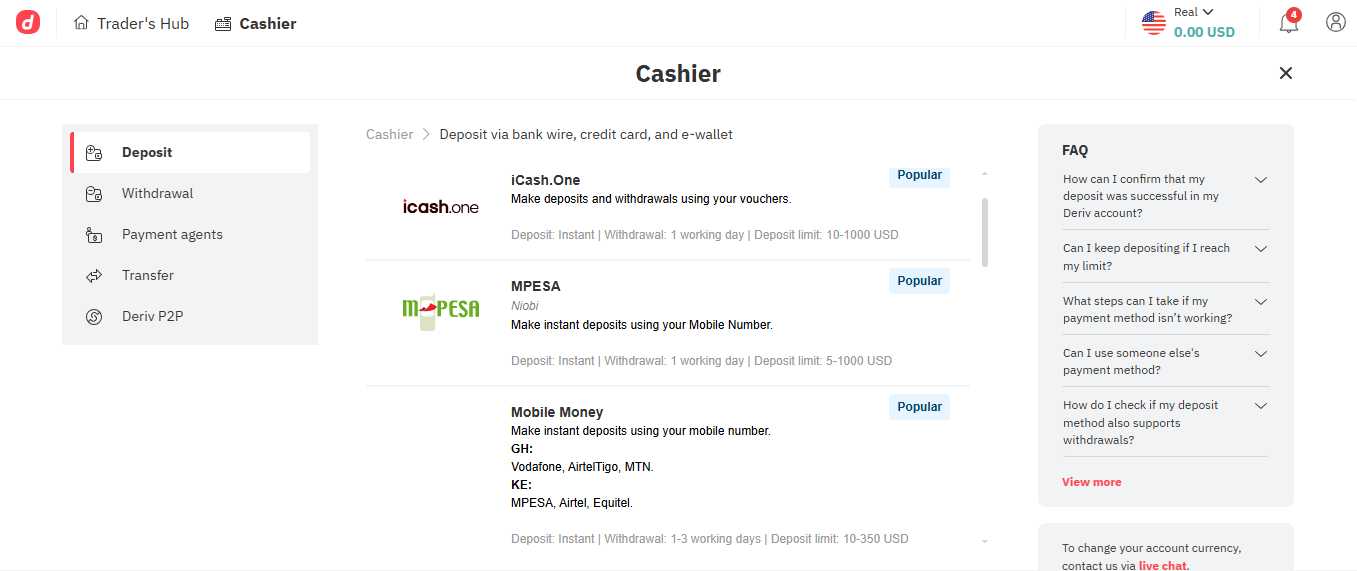
Reality: You can start on Deriv with as little as $5 via MPesa. But starting small means earning small — and that’s perfectly fine in the beginning. The goal when you’re starting is not to make money; it’s to learn without losing significant amounts. Small accounts are ideal for that purpose.
Myth 7: “Someone Else Can Trade For You and Make You Rich”
Reality: This is the premise of almost every trading scam in Kenya. Strangers on WhatsApp and Telegram offering to manage your Deriv account and share profits are almost universally scammers. They take your money, show you some early fake returns, then disappear. Real professional money managers are regulated, licensed, and require substantial minimum investments — they are not sliding into your DMs.
Who Actually Makes Money on Deriv?
To give you a realistic picture, here are the profiles of traders who genuinely make money on the platform — and what separates them from those who don’t.
The Patient Learner — spent 3–6 months studying and demo trading before touching real money. Made plenty of mistakes on demo, learned from them, and entered real trading with a tested strategy and clear rules. Started with a small real account, grew it slowly.
The Risk Manager — obsessed with protecting capital. Never risks more than 1–2% per trade. Has a strict daily loss limit. Reduces position size after a losing streak rather than increasing it. Makes modest but consistent returns month after month.
The Specialist — focuses on one or two specific instruments they know deeply. Understands how EUR/USD behaves during the London session, or how Volatility 25 moves during specific market conditions. Doesn’t try to trade everything.
The Long-Term Thinker — doesn’t measure success by daily profit. Measures it over weeks and months. Accepts that some days will be losing days and that’s fine. Stays consistent with a plan and trusts the process over time.
Realistic Expectations: What Your First Year of Trading Looks Like
Months 1–3: Learning phase. You’re studying markets, practicing on demo, making lots of mistakes. If you trade real money in this phase, treat any losses as tuition fees. Your goal is knowledge, not profit.
Months 4–6: Developing phase. You have a strategy you’re testing. You’re keeping a journal. You’re starting to understand your own emotional patterns. You may have some profitable weeks but also losing ones. This is normal.
Months 7–12: Refining phase. Your strategy is clearer. Your risk management is becoming automatic. You might start seeing consistent small profits. This is encouraging — but don’t get overconfident. Keep the position sizes small.
Year 2 and beyond: This is where consistent profitability becomes genuinely realistic for those who’ve stuck with the process. Capital has grown (slowly), skills are solid, and emotional reactions to wins and losses are more controlled.
Most people give up somewhere in months 1–3 and conclude that “trading doesn’t work.” The traders who make it are the ones who treat the first year as school, not as a money machine.
Pros and Cons of Trading on Deriv for Income
Pros
- Genuine potential for income with the right skills and capital
- MPesa integration makes deposits and withdrawals seamless for Kenyans
- Low barrier to entry — start learning with a free demo account
- Flexible hours — synthetic indices run 24/7, fitting around other commitments
- Scalable — as skills and capital grow, income potential grows with them
- No boss, no fixed location — complete flexibility for those who master it
Cons
- Most beginners lose money — the learning curve is real and costly if rushed
- Small accounts produce small returns — meaningful income requires meaningful capital
- Psychologically demanding — losses affect confidence and decision-making
- No guaranteed salary — income is inconsistent, especially in the early stages
- Scammers and fake gurus target Deriv users aggressively in Kenya
- Synthetic indices have a house edge — not suitable as the sole focus for income
Expert Tips for Anyone Serious About Making Money on Deriv
Think of your first deposit as tuition, not investment. If you start with $50 and lose it while learning, that’s one of the cheapest educations in trading you’ll ever get. Don’t be devastated — be educated.
Focus on percentage returns, not shilling amounts. A 5% monthly return on $500 is exactly as skillful as a 5% return on $50,000. Build the skill first. The account size can grow later.
Never trade money you can’t afford to lose. This is not a legal disclaimer — it’s practical advice. Trading with money you desperately need creates emotional pressure that guarantees bad decisions.
Track everything. Your journal is your most valuable tool. After 100 trades, patterns emerge that you simply cannot see trade by trade. Are you worse after lunch? Do you overtrade on Fridays? Do you cut winners too early? Your journal tells you.
Be very suspicious of overnight success stories. Every trader showing massive profits on social media is either showing their best results, using a demo account, or approaching a blowup they won’t post about. Real trading progress is slow and boring, not viral content.
FAQs: Can You Make Money on Deriv?
1. How much money can you realistically make on Deriv per month?
A realistic monthly return for a skilled trader is 3–10% of their account balance. On a $1,000 account, that’s $30–$100 per month. Meaningful monthly income requires a capital base of several thousand dollars, which most beginners don’t start with. Treat early trading as skill-building, not income generation.
2. How long does it take to start making money on Deriv?
Most traders need 6–18 months of serious study and practice before achieving consistent profitability. Those who rush it and skip the learning phase almost always lose money. Patience and preparation are the most reliable shortcuts.
3. What percentage of Deriv traders make money?
Deriv doesn’t publish a specific figure, but industry-wide research consistently shows 20–30% of retail traders are profitable over time. The majority lose money, primarily due to poor risk management and lack of strategy — not because the platform is flawed.
4. Can I make a living from trading on Deriv?
It’s possible but it requires: a trading account large enough to generate meaningful income (typically $10,000+), at least 1–2 years of consistently profitable trading, and strong psychological resilience. It is not realistic as a goal for beginners and should not be used as a reason to quit stable employment.
5. Is Deriv better for making money than other platforms?
Deriv’s unique selling point is synthetic indices — markets you can’t trade anywhere else. For Kenyan traders specifically, MPesa integration and low minimum deposits make it highly accessible. Whether it’s “better” than other platforms depends on which instruments you trade — the skill of the trader matters far more than the platform choice.
6. Can you make money on Deriv with a small account like $50?
You can learn to trade profitably with a $50 account — but you won’t generate meaningful income from it. At 5% monthly returns, $50 earns $2.50. The value of a small account is learning real-money emotions and building discipline. Treat it as a stepping stone, not a salary.
7. Are the profits on Deriv real? Can you actually withdraw them?
Yes. Deriv is a legitimate, regulated platform. Profits are real and withdrawable. Kenyan traders regularly withdraw via MPesa. Withdrawal requests are typically processed within 1–3 business days. There are occasional delays during high-volume periods but funds are not withheld from legitimate accounts.
8. What is the fastest way to make money on Deriv?
There is no legitimate “fast” way. The fastest reliable path is: study for 2–4 weeks, demo trade for 60+ days, develop solid risk management habits, then transition to real money carefully. Anyone promising a faster shortcut is either selling something or misleading you.
Conclusion: The Honest Verdict on Making Money on Deriv
Can you make money on Deriv? Yes — with the right preparation, realistic expectations, and genuine discipline.
Can you make quick, easy money on Deriv? No — and anyone who tells you otherwise is not being honest with you.
The traders making real income from Deriv are not special or uniquely gifted. They’re simply people who respected the learning process, managed their risk carefully, and kept going when it got difficult. That path is open to anyone willing to walk it.
Start where every successful trader started — with a free demo account, zero pressure, and a commitment to learning before earning.
👉 Open your free Deriv demo account here — practice with virtual money, test your strategy, and only move to real funds when you’re genuinely ready.
Read also:
- How Much Money Do You Need to Start Trading on Deriv in Kenya?
- How to Make Profit on Deriv: Strategies, Risk Management and Honest Tips
- Best Strategy for Deriv Trading
TIMEBUCKS
Low minimum
payout of just
$3 — start
earning today!