 TIMEBUCKS
Low minimum
payout of just
$3 — start
earning today!
If you’ve been searching for how to make profit on Deriv, you’re not alone. Thousands of Kenyan traders open accounts on Deriv every month hoping to turn a profit — but most end up losing money before they ever figure out what went wrong.
Here’s the truth: making consistent profit on Deriv is possible, but it is not easy and it is not quick. It requires a real strategy, strict risk management, and the discipline to follow rules even when emotions are screaming at you to do otherwise.

This guide will show you exactly what profitable trading on Deriv looks like — the strategies that work, the habits that protect your account, and the honest realities you need to accept before risking a single shilling.
How Do You Make Profit on Deriv?
To make profit on Deriv, you need a tested trading strategy, strict risk management (never risk more than 1–2% per trade), and the discipline to follow your plan consistently. Profit comes from executing a good strategy correctly over many trades — not from winning every single one.
The Right Mindset: What Profitable Trading Actually Looks Like
Before diving into strategies, let’s reset expectations — because most beginners start with completely wrong assumptions.
Profitable trading does NOT look like:
- Winning every trade
- Making thousands in your first week
- Finding a “secret” indicator that predicts price perfectly
- Copying signals blindly and printing money
Profitable trading DOES look like:
- Winning 50–60% of trades while keeping losses small
- Making slightly more on winners than you lose on losers
- Being consistent over hundreds of trades, not just a few
- Boring, disciplined, rule-based decisions every single day
A trader who wins 55% of trades and makes $20 on wins while losing $15 on losses is genuinely profitable over time. That’s not glamorous — but it’s real. Keep this in mind as you read everything below.
Profitable Trading Strategies on Deriv

There is no single “best” strategy — the best strategy is the one you understand deeply, have tested thoroughly, and can execute without second-guessing yourself. Here are the most proven approaches for Deriv traders.
Strategy 1: Support and Resistance Trading
This is the foundation of most profitable trading and the best starting point for beginners.
What it is: Support is a price level where the market tends to stop falling and bounce up. Resistance is where the market tends to stop rising and pull back. When price approaches these key levels, it often reacts predictably.
How to use it on Deriv:
- Open a chart on DTrader or Deriv MT5 and zoom out to see the bigger picture
- Identify clear horizontal levels where price has reversed multiple times in the past
- Wait for price to approach one of these levels again
- Look for a confirmation signal — a rejection candle, a pin bar, or a bounce — before entering
- Set your stop loss just beyond the support/resistance level
- Target the next key level for your take profit
Why it works: These levels exist because large numbers of traders and institutions react to the same price points. When enough people act at a level, the price movement becomes self-fulfilling.
TIMEBUCKS
Low minimum
payout of just
$3 — start
earning today!
Best for: Forex pairs on Deriv MT5, commodities like Gold
Strategy 2: Trend Following
The classic trading saying is “the trend is your friend” — and it’s a cliché because it’s true.

What it is: Trending markets move consistently in one direction — either up (bullish) or down (bearish). Trend following means identifying the direction and only taking trades in that direction.
How to apply it:
TIMEBUCKS
Low minimum
payout of just
$3 — start
earning today!
- Add a 50-period and 200-period moving average to your chart
- If the 50MA is above the 200MA, the trend is up — only look for buy entries
- If the 50MA is below the 200MA, the trend is down — only look for sell entries
- Wait for price to pull back toward the moving averages before entering
- Enter in the direction of the trend when price shows signs of resuming
Why it works: Trending markets carry momentum. Trading with the trend puts the probability on your side rather than fighting the dominant market direction.
Best for: Forex pairs, synthetic indices with clear directional movement
Strategy 3: Price Action Trading (No Indicators)
Price action trading means reading the market purely through candlestick patterns and chart structure — no indicators needed. Many professional traders use nothing but price action.
Key candlestick patterns to learn:
- Pin bar (Hammer/Shooting Star) — a candle with a long wick and small body, showing strong rejection of a price level. A bullish pin bar at support signals a potential move up; a bearish pin bar at resistance signals a potential move down.
- Engulfing candle — a large candle that completely “engulfs” the previous one. A bullish engulfing at support is a strong buy signal; a bearish engulfing at resistance is a strong sell signal.
- Inside bar — a smaller candle contained within the previous candle’s range. Shows indecision and often precedes a strong breakout in either direction.
How to use on Deriv: Combine these patterns with support/resistance levels. A pin bar at a key support level is far more powerful than a pin bar in the middle of nowhere.
Best for: All markets on Deriv — forex, gold, synthetic indices
Strategy 4: Breakout Trading
Markets don’t trend forever. They alternate between trending and ranging (moving sideways). Breakout trading aims to catch the moment a ranging market breaks out and starts trending.
How to trade breakouts:
- Identify a consolidation zone — price bouncing between a clear top and bottom for a period of time
- Draw horizontal lines at the top (resistance) and bottom (support) of the range
- Wait for price to close convincingly above resistance or below support
- Enter in the direction of the breakout
- Set stop loss inside the previous range
- Target a move equal to the height of the range
Warning: Fake breakouts are common — price briefly breaks out then reverses. Wait for a candle to fully close beyond the level before entering, rather than jumping in the moment the level is touched.
Best for: Forex pairs during major economic announcements, Boom/Crash indices on Deriv
Strategy 5: Trading Synthetic Indices on Deriv
Deriv’s synthetic indices — Volatility 10, 25, 50, 75, 100 and Crash/Boom indices — are unique to Deriv and deserve their own approach.
Important things to understand first:
- These are computer-generated markets, not real-world assets
- They run 24/7 so there is no “best time” based on market sessions
- They cannot be analyzed with fundamental analysis — technical analysis only
- Higher volatility numbers (V75, V100) move faster and are riskier
Practical tips for synthetic indices:
- Start with Volatility 10 or Volatility 25 — they move more slowly and are less punishing for beginners
- Use the same technical analysis tools — support/resistance, moving averages, price action
- Avoid Crash/Boom indices until you’re experienced — they have sudden spikes that can hit stop losses instantly
- Keep position sizes very small — these markets can move sharply with no warning
How to Win Trades Consistently: The Truth
“Winning consistently” does not mean winning every trade. It means having a positive overall result over a large sample of trades. Here’s what consistency actually requires:
Have an Edge
An “edge” means your strategy wins more often than it loses, or wins enough to be profitable even if it loses more often than it wins. You cannot have an edge without testing your strategy on historical data and tracking your results over at least 50–100 trades.
Follow Your Rules Every Time
The biggest killer of consistency is deviation from your own plan. You see a trade that “looks good” even though it doesn’t meet your strategy criteria — so you take it anyway. This is called impulse trading and it destroys consistency.
Write your trading rules down. Before every trade, check that it meets every single rule. If it doesn’t — do not take it.
Accept That Losing Trades Are Part of the Process
Even the world’s best traders lose 40–50% of their trades. What makes them profitable is that their winners are bigger than their losers. When you accept that losses are a normal part of trading — not failures — you stop making emotional decisions after bad trades.
Trade Less, Not More
More trades do not equal more profit. In fact, overtrading is one of the most common causes of losses. Taking 3 high-quality, well-planned trades per week will almost always outperform taking 20 random trades per day.
Trading Risk Management Tips: Protecting Your Account
Risk management is what separates traders who last from those who blow their accounts in a month. No strategy, no matter how good, will save you without proper risk management.
The 1–2% Rule
Never risk more than 1–2% of your total account balance on a single trade. This sounds small but it is the foundation of account survival.
If your Deriv account has $100:
- Maximum risk per trade = $1–$2
- Even 10 losing trades in a row only costs you $10–$20
- Your account survives to fight another day
If you risk 20% per trade and lose 5 in a row — which happens to every trader — your account is gone.
Always Use a Stop Loss
A stop loss is a pre-set price level where your trade automatically closes if it moves against you. It is your safety net. Trading without a stop loss is like driving without a seatbelt — fine until it isn’t.
Set your stop loss before you enter a trade. Place it at a logical level on the chart — beyond a support/resistance level, not just a random number of pips away.
Use a Positive Risk-to-Reward Ratio
Your risk-to-reward ratio (R:R) compares how much you risk on a trade to how much you stand to gain. A 1:2 R:R means you risk $10 to potentially make $20.
With a 1:2 R:R, you only need to win 34% of your trades to be profitable. With 1:3, you can lose twice as often as you win and still make money.
Always aim for at least 1:1.5 or 1:2 on every trade. Never take a trade where the potential loss is greater than the potential gain.
Control Your Leverage
Deriv offers leverage up to 1:1000 on some instruments. For beginners and intermediate traders, this is extremely dangerous. High leverage means a small price movement can wipe your account.
Practical leverage guidelines:
- Complete beginners: 1:10 maximum
- Intermediate traders: 1:50 maximum
- Only use high leverage when you fully understand the consequences
Set a Daily Loss Limit
Decide before you start trading each day: “If I lose X amount today, I stop.” A sensible limit is 3–5% of your account. When you hit it — stop. Close the platform. Come back tomorrow.
This rule exists to protect you from the most dangerous kind of trading: emotionally-driven revenge trading after a bad day.
How to Avoid Losses in Trading
You cannot avoid all losses — they are a guaranteed part of trading. But you can absolutely avoid the kind of losses that destroy accounts. Here’s how:
Avoid trading during major news events (unless you have experience with volatility). Events like US Non-Farm Payrolls, central bank interest rate decisions, and inflation announcements can cause extreme, unpredictable price spikes. Check an economic calendar before trading forex and step aside during high-impact news.
Avoid holding losing trades hoping they recover. This is one of the most account-destroying habits. If your stop loss is hit, your trade was wrong. Accept it and move on. The market does not owe you a recovery.
Avoid adding to losing positions. “Averaging down” — buying more of an instrument as it falls, hoping to lower your average price — turns small losses into catastrophic ones. Never add to a losing trade.
Avoid trading when you’re emotional. Angry, anxious, excited, sleep-deprived — all of these states impair judgment. If you’re not calm and clear-headed, don’t trade. The market will be there tomorrow.
Avoid trading assets you don’t understand. If you don’t know what moves Gold, don’t trade Gold. If you don’t understand how Crash/Boom indices work, leave them alone until you’ve studied them properly.
Pros and Cons of Trading for Profit on Deriv
Pros
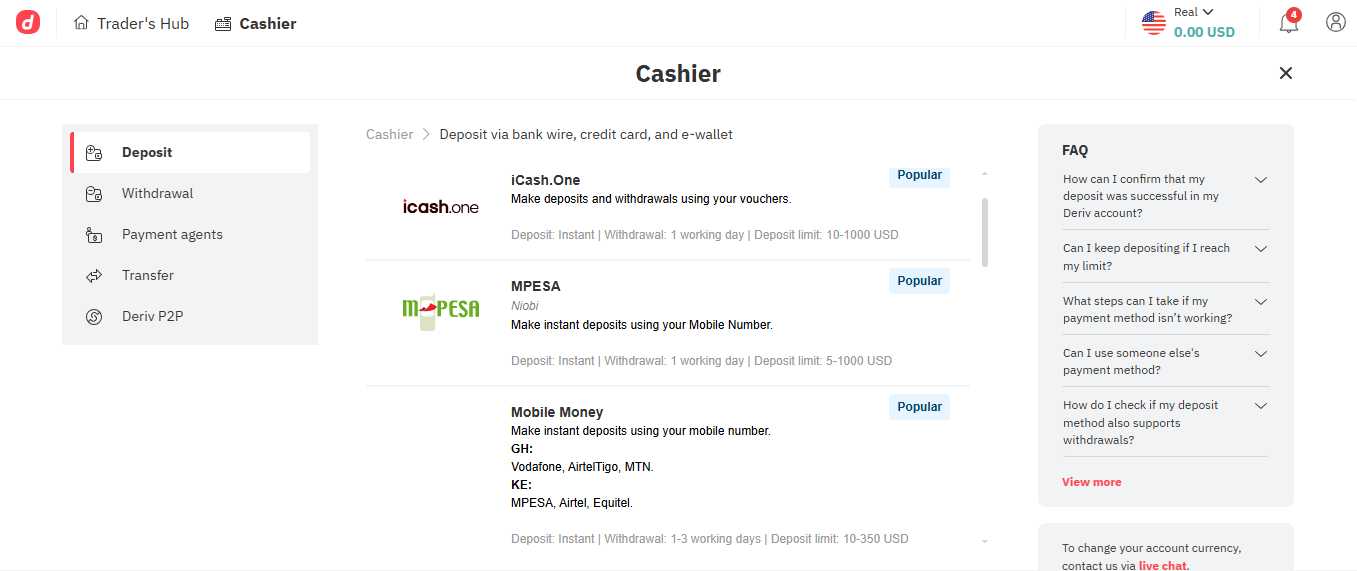
- Low minimum deposit — accessible starting from KES 650 via MPesa
- Free demo account to test strategies before risking real money
- Wide range of instruments — forex, synthetics, commodities, indices
- MT5 platform available — industry standard with powerful charting tools
- 24/7 synthetic indices allow flexible trading hours for Kenyan traders
- Deriv Academy provides free strategy and platform education
Cons
- High-risk products — easy to lose money fast, especially on synthetic indices
- Leverage can magnify losses as quickly as gains
- Emotional pressures of real-money trading are hard to prepare for
- No strategy works 100% of the time — losing streaks will happen
- Online “signal sellers” and fake gurus target Deriv traders aggressively
Expert Tips: What Profitable Deriv Traders Do Differently
They have a written trading plan. Everything is defined before they open the platform: which markets, which timeframe, which setups, how much risk per trade, daily loss limit. There’s no improvising.
They review their trades weekly. At the end of each week, they go through their journal and ask: Which trades followed my plan? Which didn’t? What can I improve? This honest self-review is how skills actually develop.
They protect their capital above everything else. When a profitable trader has a losing streak, they reduce their position sizes — not increase them. Capital preservation is the priority; making money is secondary.
They are selective. They don’t take every trade that vaguely looks promising. They wait for high-probability setups that meet all their criteria. Quality over quantity, every time.
They separate their trading account from their emotions. A loss is a business expense, not a personal failure. A win is a result of executing a plan correctly, not a reason to immediately size up and take bigger risks.
FAQs: How to Make Profit on Deriv
1. Is it really possible to make consistent profit on Deriv?
Yes, it is possible — but it requires months or years of learning, practice, and discipline. Most traders who make consistent profit have spent significant time studying, demo trading, and refining their approach. It is not quick or easy, but it is achievable with the right commitment.
2. What is the best strategy for beginners on Deriv?
Support and resistance trading combined with basic price action (pin bars and engulfing candles) is the most beginner-friendly approach. It requires no complex indicators, teaches you to read charts properly, and applies across all of Deriv’s instruments.
3. How much do I need to make profit on Deriv?
You can technically start with $5 via MPesa. However, a more practical starting amount for real trading is $50–$100. With proper risk management (1–2% per trade), a $100 account allows you to take meaningful trades while limiting losses to $1–$2 per trade.
4. Can I make daily profit trading on Deriv?
Some experienced traders do make daily profit — but this is not realistic for beginners and should not be your initial goal. Focus on being profitable over weeks and months, not every single day. Even professional traders have losing days.
5. What is the best Deriv product to trade for profit?
For beginners, forex pairs on Deriv MT5 (like EUR/USD or GBP/USD) are the most accessible. For those interested in synthetic indices, start with Volatility 10 or Volatility 25 as they are less volatile than higher-numbered indices.
6. How do I avoid losing all my money on Deriv?
The three most important protections are: always use a stop loss, never risk more than 1–2% per trade, and set a daily loss limit. These three rules alone will prevent the account-destroying losses that most beginners experience.
7. Does Deriv allow scalping and day trading?
Yes. Deriv supports scalping (very short-term trades), day trading, and swing trading. Synthetic indices in particular are popular for scalping due to their 24/7 availability. However, scalping requires fast decision-making and is not recommended for complete beginners.
8. How long does it take to become profitable on Deriv?
For most self-taught traders, expect 6–18 months of serious study and practice before achieving consistent profitability. Some take longer. The key factor is not how fast you learn, but how disciplined and honest you are about your own weaknesses and mistakes.
Conclusion: Profit on Deriv Is Earned, Not Stumbled Upon
The traders who make genuine, consistent profit on Deriv are not lucky. They are prepared. They have a strategy they believe in because they’ve tested it. They manage their risk so carefully that no single trade can damage their account significantly. And they approach every session with discipline and a clear plan.
If that sounds like hard work — it is. But it’s also a learnable skill. And every expert was once a beginner who had no idea what they were doing.
Your next steps:
- Pick one strategy from this guide and study it deeply
- Open a free demo account and test your strategy for at least 60 days
- Keep a trading journal from your very first trade
- Move to real money only when your demo results are consistently positive
👉 Start practising on a free Deriv demo account here — no deposit required, no risk, just learning.
Read also:
- How Much Money Do You Need to Start Trading on Deriv in Kenya?
- Best Deriv Account for Beginners
- How to Start Trading With No Experience
TIMEBUCKS
Low minimum
payout of just
$3 — start
earning today!