
 TIMEBUCKS
Low minimum
payout of just
$3 — start
earning today!
If you’ve been wondering how much money to start trading on Deriv, the honest answer is: you can technically start with as little as $5 — that’s roughly Ksh 650 at today’s exchange rate.
But there’s a difference between the minimum you can deposit and the realistic amount you should start with.

This guide breaks it all down in plain terms — what the deposit minimums actually are, whether you can trade with Ksh 100, and the smart low-budget strategies that give small accounts the best chance of survival.
Minimum Deposit on Deriv in Kenya
The minimum deposit on Deriv is $5 USD — one of the lowest in the online trading industry, well below the average minimum deposit of $310 found among over 300 brokers. For Kenyan traders, this $5 minimum applies to MT5, cTrader, and Options Trader accounts and can be funded via M-Pesa.
In Kenyan shillings, the key deposit thresholds look like this:
| Payment Method | Minimum Deposit | Approx. KES |
|---|---|---|
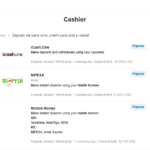
| Cryptocurrency (Bitcoin, USDT, ETH) | $5 | ~Ksh 650 |
| M-Pesa | $10 | ~Ksh 1,300 |
| Airtel Money / Equitel | $10 | ~Ksh 1,300 |
| E-wallets (Skrill, Neteller) | $10 | ~Ksh 1,300 |
| Bank Transfer | $50 | ~Ksh 6,500 |
Exchange rates fluctuate. Check the current USD/KES rate before depositing.
Can I Trade Deriv with Ksh 100?
This is one of the most common questions asked by Kenyan beginners — and the honest answer is: no, not with M-Pesa. The M-Pesa minimum deposit is $10 (around Ksh 1,300), so Ksh 100 falls well below the threshold.
The only way to get started with an amount close to Ksh 100 is through cryptocurrency, where the minimum deposit is $5 (around Ksh 650). But even then, you would also need to pay crypto network (gas) fees on top, which could eat into a very small deposit.
More importantly — even if you could deposit Ksh 100, it would not be practical. With stakes starting from as low as $0.35 on some trade types, you might place a handful of trades, but a few losses would wipe out the account immediately. You would have no room for error, no ability to recover from a bad trade, and nothing to learn from.
The realistic starting point for Kenyan traders is Ksh 1,300 to Ksh 2,600 ($10–$20). This gives you enough room to place real trades, apply a strategy, and learn without losing everything in one or two bad sessions.
What is a Realistic Starting Amount for Deriv in Kenya?
There’s an important difference between what’s possible and what’s practical. Here’s a realistic breakdown by budget level:
Ksh 1,300 – Ksh 2,600 ($10 – $20): Learning Budget
This is the most common starting point for Kenyan beginners. You can fund via M-Pesa, place real trades with stakes of $0.35–$1, and get a feel for live market conditions without serious financial exposure. Expect to lose this amount while you’re still learning — treat it like a tuition fee.
Best for: Complete beginners who want to test live trading after practicing on demo.
TIMEBUCKS
Low minimum
payout of just
$3 — start
earning today!
Ksh 2,600 – Ksh 6,500 ($20 – $50): Starter Budget
With this range, you have enough breathing room to apply a basic strategy, absorb a few losses, and still have capital remaining to trade. You can stake $1–$2 per trade while keeping risk per trade below 5% of your account.
Best for: Beginners who have spent time on demo and are ready to trade seriously with small, disciplined stakes.

Ksh 6,500 – Ksh 13,000 ($50 – $100): Comfortable Budget
At this level, you have meaningful capital to work with. You can keep stake sizes small (1–2% per trade), absorb losses more comfortably, and give a strategy enough trades to prove itself over time. This is where proper risk management becomes genuinely possible.
Best for: Traders with some demo experience who want to trade consistently with a structured approach.
TIMEBUCKS
Low minimum
payout of just
$3 — start
earning today!
Ksh 13,000+ ($100+): Serious Budget
Anything above $100 allows you to trade with proper position sizing, follow a real risk management plan, and have a realistic chance of growing the account sustainably. Most experienced traders recommend a minimum of $100–$200 for anyone treating trading seriously.
Best for: Traders who have done their time on demo, have a strategy, and are treating trading as a real skill to develop.
Key takeaway: The minimum deposit is $5–$10, but the practical starting amount for anyone wanting a fair chance to learn and succeed is $20–$50 (Ksh 2,600–6,500).
Minimum Deposit on Deriv Kenya: Payment Method Breakdown
M-Pesa (Most Popular in Kenya)
Deriv supports M-Pesa, Airtel Money, and Equitel for Kenyan traders, making it one of the most accessible international brokers for local payments.
- Minimum deposit: $10 (approx. Ksh 1,300)
- Processing time: Usually instant to 1 working day
- Fees: Deriv charges no deposit fees. Standard Safaricom M-Pesa transaction charges may apply.
Cryptocurrency
- Minimum deposit: $5 (approx. Ksh 650)
- Accepted: Bitcoin (BTC), Ethereum (ETH), Tether (USDT), Litecoin, and others
- Processing time: 30–60 minutes depending on network congestion
- Note: You need an existing crypto wallet and some crypto already purchased. This adds steps for beginners.
E-Wallets (Skrill, Neteller, AirTM)
- Minimum deposit: $10
- Processing time: Usually instant
- Best for traders who already use e-wallet services
Bank Transfer
- Minimum deposit: $50 (approx. Ksh 6,500)
- Processing time: 1–3 business days
- Best for larger deposits
Deriv does not charge any fees for deposits. However, fees may still be applied by the payment system used. Always check if your M-Pesa transaction or bank transfer carries its own charge.
Low Budget Trading Strategies on Deriv
Starting with a small account doesn’t mean you can’t trade — it just means you have to be smarter about how you trade. Here are the most effective low-budget strategies used by Kenyan traders on Deriv:
1. Fixed Stake Strategy (Best for Beginners)
The simplest approach: choose a fixed stake amount and stick to it on every single trade, regardless of whether your last trade won or lost.
How it works:
- Decide your stake, e.g., $0.50 or $1 per trade
- Never increase it after a loss
- Never increase it after a win out of excitement
- Set a daily limit — stop trading after 5 losses in a row
Why it works for small accounts: It stops you from emotionally escalating your stake when things go wrong, which is how most small accounts blow up.
2. The 2% Rule
Never risk more than 2% of your total account balance on a single trade.
| Account Balance | 2% Stake |
|---|---|
| $10 (Ksh 1,300) | $0.20 |
| $20 (Ksh 2,600) | $0.40 |
| $50 (Ksh 6,500) | $1.00 |
| $100 (Ksh 13,000) | $2.00 |
This rule keeps your account alive through a losing streak. Even 10 losses in a row only reduces a $50 account by $10 — painful, but survivable.
3. Rise/Fall on Volatility 10 (Lowest Volatility Index)
For small accounts, the Volatility 10 Index is the safest synthetic index to trade. It moves more slowly and predictably than Volatility 75 or Boom/Crash, giving you more time to read the market and less chance of sudden wipeouts.
Approach:
- Trade Rise/Fall on Volatility 10
- Use a 5–15 minute duration
- Only enter when you have a reason — not just randomly
- Aim for 3–5 good trades per day, not dozens
4. Even/Odd Digits Strategy
Even/Odd is one of Deriv’s simplest trade types. You predict whether the last digit of the price will be an even number (0, 2, 4, 6, 8) or an odd number (1, 3, 5, 7, 9).
- Payout: approximately 95% of your stake if correct
- Minimum stake: As low as $0.35
- Duration: As short as 1 tick
This works well for small accounts because the minimum stake is very low. However, it’s still a 50/50 bet at its core — don’t mistake simplicity for an edge. Use it as a tool to practice discipline, not as a shortcut to profits.
5. Set Daily Profit and Loss Targets
Successful small account traders in Kenya use strict daily limits:
- Daily profit target: Stop trading once you’ve made 5–10% of your balance
- Daily loss limit: Stop trading once you’ve lost 10–15% of your balance
- Walk away rule: If you hit your loss limit, close the app. Do not try to recover.
This is arguably the most important strategy for a small account. The market will always be there tomorrow. Your account may not be if you keep chasing losses.
Pros and Cons of Starting with a Small Account on Deriv
✅ Pros
- Very low financial risk — losing $10–$20 while learning is manageable
- Forces discipline — small accounts punish reckless trading immediately
- Real market experience — better than demo once you’ve learned the basics
- Easy to top up via M-Pesa anytime
- No minimum account size requirement after your first deposit
❌ Cons
- Very small stakes limit learning — you can’t trade in realistic position sizes
- Psychological pressure — every trade feels significant when your balance is tiny
- Hard to apply proper risk management at $10 (2% = $0.20 per trade, very small)
- Easy to lose the whole account with a few bad decisions
- Temptation to increase stakes to “grow faster” — this usually backfires
Common Mistakes Kenyan Traders Make with Small Accounts
Depositing more after blowing the first account without changing habits. If you lost Ksh 1,300 on your first deposit, the problem is rarely the amount — it’s the approach. Spend more time on demo before adding more money.
Using the Martingale strategy. This is where you double your stake after every loss, hoping to recover. On a small account, two or three losses in a row will wipe you out completely before you get a chance to recover. Avoid this completely.
Trading too many times per day. More trades = more opportunities to lose. Focus on quality over quantity. Three well-thought-out trades are better than thirty random ones.
Chasing losses. This is the fastest way to go from a small account to an empty one. If the market goes against you three times, that’s a sign to stop — not to trade harder.
Ignoring the free demo account. Deriv’s demo account gives you $10,000 in virtual funds, allowing you to explore different trading strategies risk-free — and it works just like a real trading account. There is no reason to skip this step.
How to Grow a Small Deriv Account: Realistic Expectations
Here is what small account growth realistically looks like if you are disciplined:
| Starting Balance | Monthly Return (Realistic 5–10%) | Balance After 6 Months |
|---|---|---|
| $10 (Ksh 1,300) | $0.50–$1/month | ~$13–$18 |
| $50 (Ksh 6,500) | $2.50–$5/month | ~$65–$90 |
| $100 (Ksh 13,000) | $5–$10/month | ~$130–$180 |
These numbers assume consistent, disciplined trading — not lucky streaks. They also assume you are not withdrawing profits during this period. Real results vary significantly and many traders experience losses, not gains.
The point of showing these numbers is not to promise returns. It’s to set realistic expectations: a small account grows slowly, and that’s completely normal. Anyone promising you 50–100% monthly returns on a small Deriv account is misleading you.
Expert Tips for Trading Deriv with a Small Budget
1. Never deposit money you cannot afford to lose. This applies at every account size, but especially at Ksh 1,300–2,600. Only trade with money that, if lost entirely, will not affect your rent, food, transport, or school fees.
2. Start with demo, always. Spend at least 2–4 weeks on Deriv’s free demo account before depositing anything. Practise risk-free, then switch to a real account when you feel confident.
3. Start with the minimum M-Pesa deposit of $10. Don’t deposit more than you’re comfortable losing when you’re still learning.
4. Use the smallest available stake on every trade. The goal at first is not to make money — it’s to learn. Keep stakes at $0.35–$1 until you have a proven strategy.
5. Withdraw small profits regularly. Don’t let your winnings accumulate indefinitely. Getting money out of the platform and into your M-Pesa wallet is how you actually benefit from trading.
6. Avoid high-volatility instruments on a small account. Volatility 100, Boom/Crash 1000, and similar products can wipe a small account in seconds. Stick to Volatility 10 or Volatility 25 to start.
7. Open your free demo account first — start here with no deposit required — and only move to real money once you’re trading consistently on demo.
Frequently Asked Questions (FAQs)
How much money do I need to start trading on Deriv in Kenya?
The minimum deposit via M-Pesa is $10 (approximately Ksh 1,300). Via cryptocurrency, you can start with as little as $5 (approx. Ksh 650). However, a practical starting amount that gives you room to learn without losing everything instantly is $20–$50 (Ksh 2,600–6,500).
What is the minimum deposit on Deriv Kenya?
The overall minimum deposit on Deriv is $5 via cryptocurrency. For M-Pesa, Airtel Money, and Equitel, the minimum is $10. Deriv does not charge deposit fees, though your payment provider may charge standard transaction fees.
Can I trade on Deriv with Ksh 100?
No. The minimum M-Pesa deposit is $10 (around Ksh 1,300), so Ksh 100 is below the threshold. Even if you could deposit this amount via crypto, it would not give you enough capital to trade meaningfully — a single or two losses would eliminate the entire balance.
What is the minimum stake per trade on Deriv?
The minimum stake varies by trade type. On digital options (Rise/Fall, Even/Odd), stakes can start from as low as $0.35 (approx. Ksh 45). On MT5 CFDs, minimum trade sizes depend on the instrument but can be as small as 0.01 lots.
What is the best low-budget trading strategy on Deriv?
For beginners with small accounts, the fixed stake strategy combined with the 2% rule is most effective. Trade Rise/Fall on Volatility 10 Index with a stake of $0.35–$1 per trade, set daily loss limits, and stop trading once you hit them. Consistency and discipline matter more than strategy complexity at this stage.
Is it worth starting with a small account on Deriv?
Yes — for the purpose of learning. A small live account teaches you things that a demo account cannot: emotional discipline, the feeling of real losses, and the temptation to chase losses. However, don’t expect significant profits from a $10–$20 account. Treat the small account as an educational investment.
How do I deposit on Deriv using M-Pesa in Kenya?
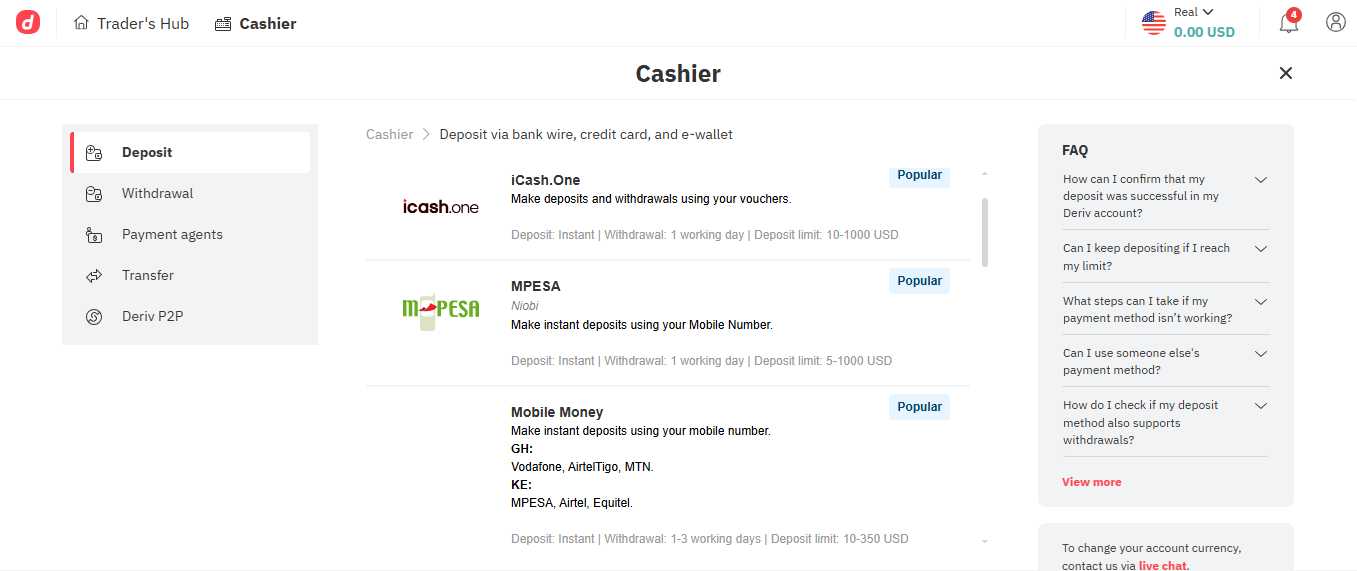
Log in → Go to Cashier → Click Deposit → Select M-Pesa → Enter amount (minimum $10) → Confirm via your phone. Funds usually arrive within minutes to 1 working day. No deposit fee is charged by Deriv.
Can I withdraw my profits from a small Deriv account?
Yes. There is no minimum withdrawal amount restriction based on your account size. You can withdraw profits once your identity is verified. Withdrawal via M-Pesa typically takes 1–3 business days. Withdraw profits regularly rather than letting them build up.
What happens if I lose all my money on Deriv?
Deriv provides negative balance protection, meaning your account balance cannot go below zero — you cannot owe Deriv money. If your account hits zero, you simply need to make a new deposit to continue trading. This is why starting with small amounts you can afford to lose is so important.
Final Verdict: How Much Should You Start With on Deriv?
The minimum deposit on Deriv is $5–$10 (Ksh 650–1,300), but the smartest starting amount for a Kenyan beginner is $20–$50 (Ksh 2,600–6,500). This range gives you enough capital to trade meaningfully, apply a basic strategy, and survive a losing streak while still learning.
More importantly, before you deposit a single shilling, spend real time on the free demo account. The traders who succeed on Deriv are not the ones who deposited the most — they are the ones who learned the most before risking real money.
👉 Start with a free Deriv demo account here — no deposit needed
Read also:
TIMEBUCKS
Low minimum
payout of just
$3 — start
earning today!