
 TIMEBUCKS
Low minimum
payout of just
$3 — start
earning today!
If you’ve been trying to decide between Deriv and Exness, you’re not alone — these two platforms are among the most popular trading brokers in Kenya right now.
Both support M-Pesa deposits, both offer low minimum deposits, and both attract thousands of Kenyan traders every month.

But they are built for very different types of traders, and choosing the wrong one can cost you more than just money.
This head-to-head comparison breaks down every key factor — regulation, spreads, platforms, payment methods, and more — so you can make a clear, informed decision.
Deriv vs Exness — Which is Better?
For synthetic indices and weekend trading: Deriv is the better choice — it’s the only broker offering 24/7 algorithm-based synthetic indices that run even on weekends.
For forex trading, tighter regulation, and lower spreads: Exness has the edge — it holds a Kenya CMA licence, offers ultra-low spreads from 0.0 pips, and has near-instant M-Pesa withdrawals.

For absolute beginners on a tight budget: Both work well, but Deriv’s $5 minimum deposit and unique demo tools make it slightly more accessible for someone starting from scratch.
The honest answer is: they’re not really competing for the same trader. Read on to find out which one is right for you specifically.
Side-by-Side Comparison: Deriv vs Exness Kenya
| Feature | Deriv | Exness |
|---|---|---|
| Founded | 1999 (as Binary.com) | 2008 |
| CMA Kenya Licence | ❌ No | ✅ Yes (Licence No. 162) |
| Other Regulation | Malta FSA, BVI FSC, VFSC, Labuan FSA | FCA (UK), CySEC (EU), FSCA (South Africa) |
| Minimum Deposit | $5 (crypto) / $10 (M-Pesa) | $10 (Standard) / $1 (Cent account) |
| M-Pesa Support | ✅ Yes | ✅ Yes |
| M-Pesa Withdrawal Speed | 1–3 business days | Near-instant (usually minutes) |
| Spreads (EUR/USD) | From ~0.5 pips (standard) | From 0.0 pips (Raw/Zero accounts) |
| Leverage | Up to 1:1000 | Up to 1:400 (CMA), Up to 1:2000 (offshore) |
| Synthetic Indices | ✅ Yes (unique, 24/7) | ❌ No |
| Forex Pairs | ✅ Yes | ✅ Yes (100+ pairs) |
| Stocks / Indices CFDs | Limited | ✅ Yes (200+ instruments) |
| Platforms | DTrader, MT5, cTrader, DBot | MT4, MT5, Exness Terminal, Exness Go App |
| Inactivity Fee | ✅ Yes ($25 after 12 months) | ❌ No inactivity fee |
| Demo Account | ✅ Free ($10,000 virtual) | ✅ Free |
| Islamic Account | ✅ Yes | ✅ Yes |
| KES Account Currency | ❌ No (USD only) | ✅ Yes (trade in KES) |
Regulation and Safety: A Critical Difference
This is the single most important difference between Deriv and Exness for Kenyan traders — and it’s not a minor one.
Exness: CMA-Regulated in Kenya
Exness operates in Kenya through Exness (KE) Limited, a locally registered company holding CMA licence number 162. The Capital Markets Authority (CMA) is Kenya’s official financial regulator, and this local licence means:
- Client funds are held in segregated Kenyan bank accounts, separate from Exness’s operational capital
- Exness must comply with Kenyan financial laws, AML/KYC protocols, and capital requirements
- Kenyan traders have legal recourse through the CMA if a dispute arises
- You are protected under the Investor Compensation Fund (covering up to Ksh 500,000 per eligible claim)
Additionally, Exness holds licences from the FCA (UK), CySEC (Cyprus), and FSCA (South Africa) — all considered Tier-1 or Tier-2 global regulators. This is among the strongest regulatory frameworks of any broker operating in Kenya.
Deriv: Not CMA-Regulated
Deriv is not licensed by Kenya’s CMA. It operates under offshore licences from Malta, the British Virgin Islands, Vanuatu, and Labuan. While these are legitimate international licences, they offer less protection for Kenyan traders specifically:
- No access to the CMA Investor Compensation Fund
- No legal recourse under Kenyan law in a dispute
- Less stringent oversight than Tier-1 regulators like FCA or CySEC
This does not mean Deriv is unsafe — it has operated since 1999 with a broadly clean track record. But it does mean Exness offers a meaningfully higher level of protection for Kenyan traders.
TIMEBUCKS
Low minimum
payout of just
$3 — start
earning today!
Verdict on Regulation: Exness wins clearly.
Spreads and Trading Costs: Which is Cheaper?
For active traders, every pip matters. Here’s how the two brokers compare on cost:
Exness Spreads
Exness is known for some of the tightest spreads in the industry, particularly on its premium accounts:
- Standard account: EUR/USD from ~0.7 pips (no commission)
- Raw Spread account: From 0.0 pips + $3.50 commission per lot per side
- Zero account: 0.0 pips on 30 major instruments (commission applies)
- Pro account: From 0.1 pips, no commission
No inactivity fee. No deposit or withdrawal fees.
TIMEBUCKS
Low minimum
payout of just
$3 — start
earning today!
Deriv Spreads
Deriv’s trading costs depend heavily on which platform and account type you use:
- Deriv MT5 Standard account: EUR/USD spreads from ~1.0–1.5 pips (no commission)
- Deriv MT5 Financial account: From ~0.5 pips
- DTrader options: Fixed pricing structure (not spread-based)
- Inactivity fee: $25 charged after 12 months of inactivity (then every 6 months)
For forex CFD trading specifically, Exness’s Raw Spread and Zero accounts offer significantly lower trading costs than Deriv’s standard accounts. However, Deriv’s proprietary options trading (Rise/Fall, digits) has a fixed premium structure that doesn’t apply traditional spreads at all.
Verdict on Spreads: Exness wins for forex CFDs. Deriv’s cost structure is different and not directly comparable for options/synthetic trading.
Unique Products: The Synthetic Indices Advantage
This is where Deriv is genuinely irreplaceable — and no comparison with Exness is complete without addressing it.
Deriv is the only broker in the world that offers synthetic indices — algorithm-driven markets that:
- Trade 24 hours a day, 7 days a week, including weekends and public holidays
- Are not affected by real-world news, economic events, or forex session timings
- Come in a range of volatility levels: Volatility 10, 25, 50, 75, 100 Index, Boom/Crash 300, 500, 1000, Step Index, and more
- Can be traded with stakes as low as $0.35
For Kenyan traders who work during the week and want to trade on Saturday or Sunday, or for those who want to practise trading without worrying about news events, synthetic indices are a significant advantage. Exness simply does not offer this product category.
Verdict on Unique Products: Deriv wins hands down. Exness has no equivalent.
Trading Platforms: What You Get With Each Broker
Deriv Platforms
- DTrader — Deriv’s proprietary web platform for digital options and synthetic indices. Simple, clean, and beginner-friendly
- Deriv MT5 — MetaTrader 5 for CFD and forex trading
- cTrader — Advanced platform for professional traders (newer addition)
- DBot — Drag-and-drop automated trading bot builder, no coding required
- SmartTrader — Legacy platform for options trading
Exness Platforms
- MetaTrader 4 (MT4) — The industry standard. Supports Expert Advisors (EAs), advanced indicators, and all automated strategies
- MetaTrader 5 (MT5) — Newer and more capable than MT4, with more markets
- Exness Terminal — Proprietary web-based platform with TradingView-style charting
- Exness Go App — Mobile-first platform with full deposit, withdrawal, and trading capability in one app
If you are already familiar with MT4 or MT5, Exness is a natural home. If you’re new and specifically interested in synthetic indices or automated bot building, Deriv’s proprietary platforms are more relevant to you.
Verdict on Platforms: Draw — depends entirely on what you trade.
M-Pesa Deposits and Withdrawals: A Key Practical Difference
Both brokers support M-Pesa for Kenyan traders — but their withdrawal speed is noticeably different.
Deriv M-Pesa
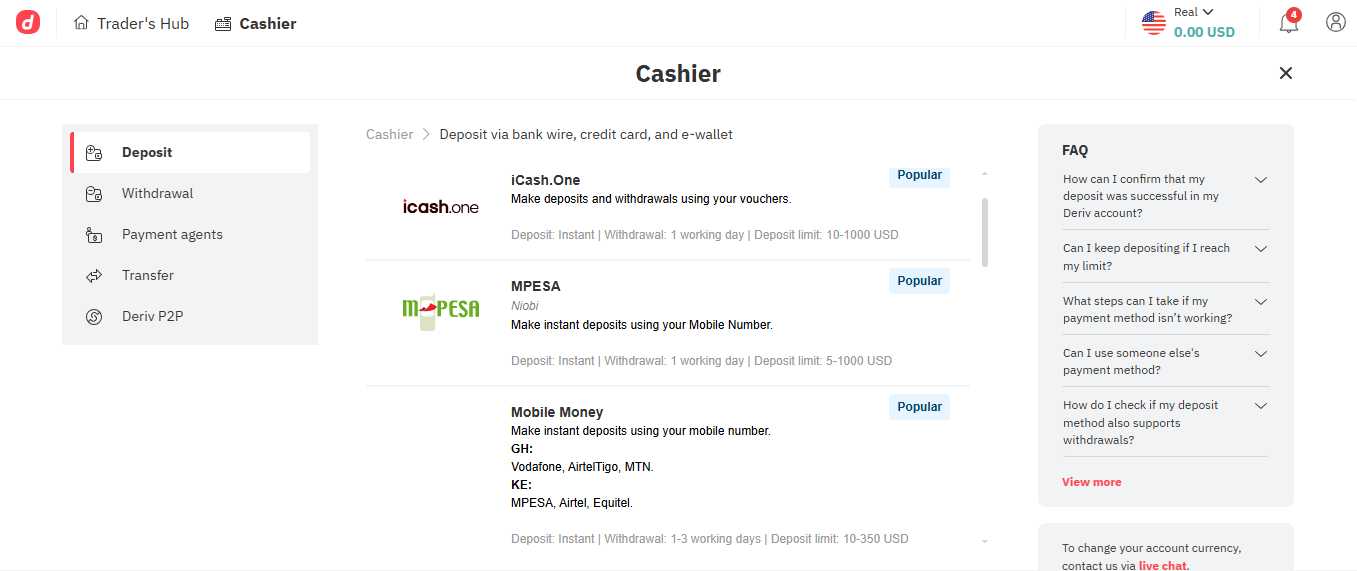
- Minimum deposit: $10 (approx. Ksh 1,300)
- Maximum deposit: $1,000 per transaction
- Deposit processing: Usually instant to 1 working day
- Withdrawal processing: 1–3 business days
- Account currency: USD (KES converted at current rate)
- Deriv charges no deposit or withdrawal fees
Exness M-Pesa
- Minimum deposit: $10 (approx. Ksh 1,300)
- Minimum withdrawal: $10
- Deposit processing: Instant
- Withdrawal processing: Near-instant (usually minutes) for verified accounts
- Account currency: Can trade in KES directly — no conversion needed
- Exness charges no deposit or withdrawal fees
The difference in withdrawal speed is significant. Exness processes M-Pesa withdrawals automatically without manual review for verified accounts, meaning most traders receive their money within minutes. Deriv’s withdrawals, while generally reliable, can take up to three business days via M-Pesa.
The ability to hold a KES-denominated account at Exness is also a meaningful advantage — it eliminates currency conversion costs and makes tracking profits in shillings straightforward.
Verdict on Payments: Exness wins on withdrawal speed and KES account support.
Beginner Friendliness: Which is Easier to Start With?
Deriv for Beginners
- Free demo account with $10,000 virtual funds
- Very low minimum deposit ($5 via crypto, $10 via M-Pesa)
- DTrader is extremely simple to navigate
- Synthetic indices are available 24/7 — no need to worry about session timing
- DBot allows automation without coding knowledge
- Limited educational resources (mainly a blog)
Exness for Beginners
- Free demo account with customisable virtual balance
- Standard Cent account allows trading with micro-lots — extremely low risk
- MT4/MT5 have a steeper learning curve than DTrader
- Extensive educational resources: webinars, tutorials, trading guides
- Exness Go mobile app is beginner-friendly
- KES account removes confusion around currency conversion
Both brokers are accessible for beginners. Deriv’s simplicity and synthetic indices make it particularly beginner-friendly for those who want to start trading immediately without worrying about market hours. Exness’s Cent account and better educational resources are a strong advantage for those focused on learning forex properly.
Verdict on Beginner Friendliness: Slight edge to Deriv for ease of starting; Exness for structured learning.
Pros and Cons Summary
Deriv Pros and Cons
✅ Pros
- The only broker offering synthetic indices (24/7 trading including weekends)
- Low minimum deposit — $5 via crypto, $10 via M-Pesa
- Multiple proprietary platforms including DBot for automated trading
- Commission-free accounts
- Negative balance protection
❌ Cons
- Not CMA-regulated — no local investor protection in Kenya
- M-Pesa withdrawals take 1–3 days (slower than Exness)
- Inactivity fee of $25 after 12 months
- No KES-denominated accounts
- Limited educational resources
Exness Pros and Cons
✅ Pros
- CMA-licensed in Kenya — full local investor protection
- Near-instant M-Pesa withdrawals (usually minutes)
- Ultra-low spreads from 0.0 pips on premium accounts
- KES-denominated accounts available
- 100+ forex pairs and 200+ instruments overall
- No inactivity fees
- Better educational resources and research tools
❌ Cons
- No synthetic indices — closed on weekends for forex
- Standard account spreads (~0.7 pips) are not as tight as premium accounts
- MT4/MT5 have a steeper learning curve than Deriv’s platforms
- Raw Spread and Zero accounts require higher volumes to justify commission costs
Which Broker Should You Choose?
Here’s the honest breakdown by trader type:
Choose Deriv if:
- You want to trade synthetic indices — Volatility indices, Boom/Crash, Step Index
- You want to trade on weekends when forex markets are closed
- You are a complete beginner who wants the simplest possible starting experience
- You want to build trading bots without knowing how to code (DBot)
- You are starting with a very small amount ($5–$20)
Choose Exness if:
- You want to trade forex seriously with tight spreads and professional conditions
- You want the security of CMA regulation and local investor protection
- You want near-instant M-Pesa withdrawals straight to your phone
- You want to trade in Kenyan Shillings (KES) without currency conversion
- You prefer the MT4 or MT5 platforms and their ecosystem of tools and EAs
- You want access to stocks, commodities, and global indices beyond synthetic products
Can you use both? Yes — and many experienced Kenyan traders do. They use Exness for serious forex trading during the week, and Deriv for synthetic indices over weekends or when they want to practise lower-stakes strategies. There’s nothing stopping you from having accounts on both platforms.
Frequently Asked Questions (FAQs)
Is Deriv or Exness better for Kenyan traders?
It depends on what you trade. Exness is better for forex trading, offering CMA regulation, tighter spreads, and near-instant M-Pesa withdrawals. Deriv is better for synthetic indices and weekend trading, as it’s the only broker in the world offering these unique 24/7 markets. Many Kenyan traders use both.
Is Exness regulated in Kenya?
Yes. Exness operates through Exness (KE) Limited, which holds a CMA licence (No. 162). It is also regulated internationally by the FCA (UK), CySEC (Cyprus), and FSCA (South Africa). This makes it one of the best-regulated brokers available to Kenyan traders.
Is Deriv regulated in Kenya?
No. Deriv does not hold a CMA licence. It operates under offshore licences from Malta, BVI, Vanuatu, and Labuan. You can legally use Deriv in Kenya, but you do not have access to local CMA investor protections.
Which broker has lower spreads — Deriv or Exness?
Exness offers lower spreads on forex pairs, especially on its Raw Spread (from 0.0 pips) and Zero accounts. Deriv’s standard MT5 spreads start from around 1.0–1.5 pips on EUR/USD. For forex CFD trading, Exness is more cost-effective for active traders.
Which broker withdraws to M-Pesa faster?
Exness is significantly faster — verified Exness accounts typically receive M-Pesa withdrawals in minutes. Deriv’s M-Pesa withdrawals take 1–3 business days. If quick access to your profits matters to you, Exness has a clear advantage here.
Can I trade synthetic indices on Exness?
No. Synthetic indices (Volatility indices, Boom/Crash, Step Index) are exclusive to Deriv. Exness does not offer this product category. If synthetic index trading is your focus, Deriv is the only option.
What is the minimum deposit for Deriv and Exness in Kenya?
Deriv’s minimum via M-Pesa is $10 (approx. Ksh 1,300). Exness’s minimum for its Standard account is also $10 via M-Pesa, but its Standard Cent account starts from just $1 (approx. Ksh 130) — the lowest entry point of the two.
Which broker is safer for Kenyan traders?
Exness is safer from a regulatory standpoint, due to its CMA licence, which provides local legal protections and access to the Investor Compensation Fund. Deriv is legitimate and has a long track record, but its offshore licences offer less protection for Kenyan traders specifically.
Is it safe to use both Deriv and Exness at the same time?
Yes. Many Kenyan traders maintain accounts on both platforms. This allows you to trade forex on Exness (with its tighter spreads and CMA protection) while using Deriv for synthetic indices and weekend trading. There is no conflict in having accounts on both.
Final Verdict: Deriv vs Exness
Neither broker is universally “better” — they serve different needs:
- Exness is the stronger choice for serious forex traders who prioritise regulation, low spreads, fast withdrawals, and trading in Kenyan Shillings.
- Deriv is irreplaceable for synthetic index traders and anyone who wants to trade on weekends or outside standard forex market hours.
If you’re just starting out and haven’t decided what to trade yet, start with a free demo account on Deriv to explore synthetic indices — no deposit required. Once you’re ready to trade forex seriously with real money, Exness’s CMA-regulated environment offers a more protected and cost-effective home for that part of your trading.
👉 Open a free Deriv demo account here — no deposit needed
Read also:
- Deriv Affiliate Program: The Complete Guide to Earning Up to 45% Commission
- Top 20 Richest Forex Traders in Kenya
- Is Forex Trading Profitable? The Complete Truth for Beginners
TIMEBUCKS
Low minimum
payout of just
$3 — start
earning today!