


Get High Paying Surveys
Earn money online by completing simple surveys. No experience needed.
Start Earning →If you’ve ever posted a TikTok that got 300 views while a stranger’s video with a shaky camera hit 3 million, you’ve met the algorithm. The TikTok algorithm is the invisible engine deciding who sees your content — and understanding it is the single most important thing you can do to grow on the platform.
This guide breaks down exactly how TikTok works, what signals matter most, and the practical TikTok FYP tips that actually move the needle in 2026.

What Is the TikTok Algorithm?
The TikTok algorithm is a recommendation system that curates each user’s For You Page (FYP) by predicting which videos they’re most likely to watch, enjoy, and engage with. Unlike follower-based feeds on Instagram or YouTube, TikTok’s FYP means any video — from any account — can reach millions of strangers.
 OLYMP TRADE
Sign up and get
10,000 USD to your
demo account to
learn trading
TikTok itself describes it as “a system that recommends content by ranking videos based on a combination of factors.” But that description barely scratches the surface.
At its core, the algorithm answers one question: “Will this viewer watch this video to the end?” Every other signal flows from that.
How TikTok Works: The Step-by-Step Process
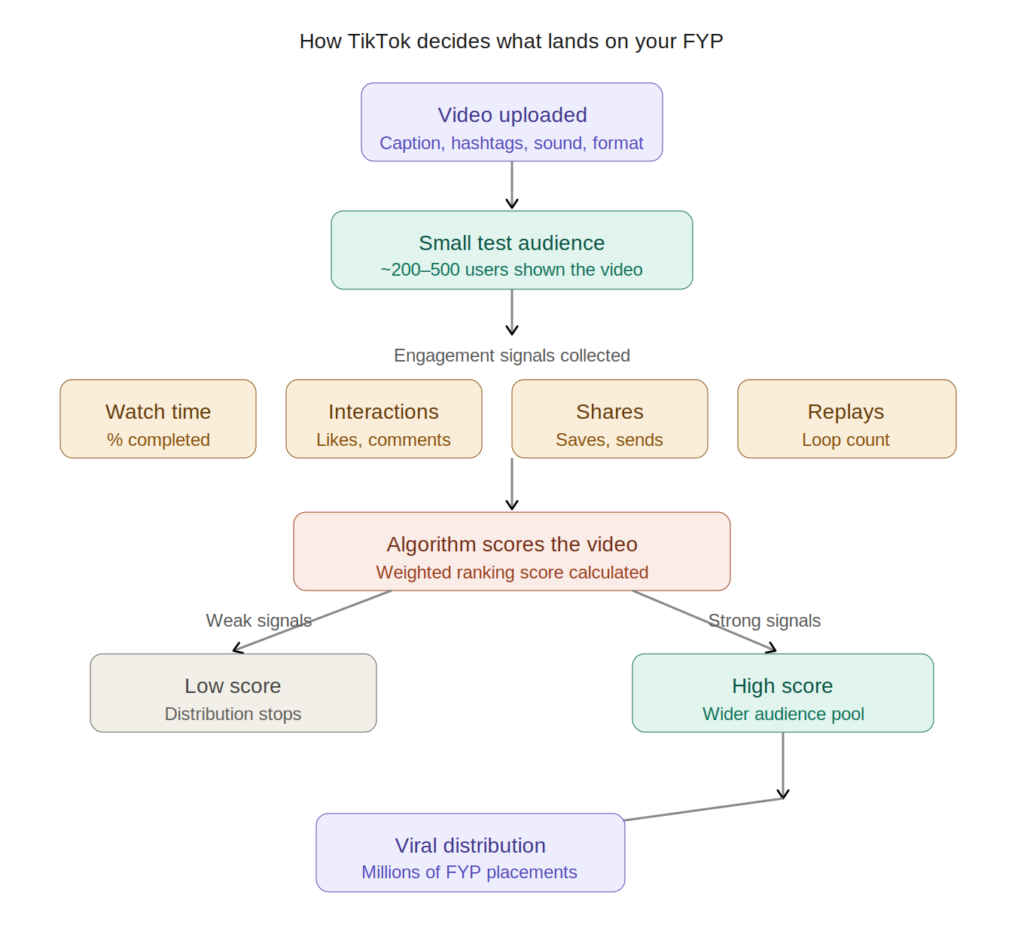
Here’s the actual lifecycle of a TikTok video — from upload to viral reach (or quiet death):
OLYMP TRADE
Sign up and get
10,000 USD to your
demo account to
learn trading

Step 1 — The test drop. When you post a video, TikTok doesn’t blast it to all your followers immediately. It first shows it to a small seed audience of roughly 200–500 users. This group is selected based on your past content, your existing audience’s profile, and the video’s metadata (caption, hashtags, sounds, on-screen text).
Step 2 — Signal collection. Within that seed group, TikTok watches closely. It tracks:
OLYMP TRADE
Sign up and get
10,000 USD to your
demo account to
learn trading
- Watch time / completion rate — Did people watch to the end? Did they replay it?
- Likes, comments, and shares — Passive approval vs. active investment
- Profile visits and follows — Did the video drive interest beyond itself?
- “Not interested” taps and skips — Negative signals are just as real
Step 3 — Scoring. The algorithm calculates a weighted performance score. Not all signals are equal. Watch time and completion rate carry the most weight. A video that gets 100 likes but a 20% completion rate will almost always lose to a video with 50 likes and an 80% completion rate.
Step 4 — Wider distribution or death. If the score clears the threshold, TikTok pushes it to a larger audience pool. Strong performance there pushes it to an even larger pool. This is why TikTok videos can explode weeks after being posted — they’re still passing successive threshold tests.
TikTok Ranking Factors: What Actually Matters Most
Understanding TikTok ranking factors helps you make better creative decisions — not just chase tactics.
1. Video Completion Rate (Highest Weight)
This is the algorithm’s north star. If viewers consistently watch your video to the last second, TikTok interprets it as high-quality content worth spreading. Loops (videos people replay) are even more powerful.

Practical implication: Don’t bury your value in the second half. Hook the viewer in the first 1–2 seconds, but make the payoff worth staying for.
2. Shares and Saves
Shares send your video to new audiences outside TikTok’s recommendation system — that’s free distribution the algorithm can’t ignore. Saves signal that the content is worth returning to, which TikTok treats as a strong intent signal.
Practical implication: Create content worth saving. Lists, tutorials, “you need to see this” moments, and strong emotional payoffs all drive saves and shares.

3. Comments
The quantity of comments matters, but so does the type. Comment threads that go on — especially when the creator replies — tell the algorithm your video created a conversation. TikTok rewards that signal heavily.
Practical implication: Post videos that end with an open question, a debate-worthy take, or something that makes people want to say “wait, but actually…”
4. Likes
Likes matter, but they’re a weak signal compared to the above three. They’re easy to give, so the algorithm discounts them somewhat. Still worth optimising for — just don’t chase likes at the expense of everything else.
5. Sound and Trend Alignment
TikTok has a powerful sound-matching engine. When you use a trending audio clip, the algorithm already knows which user segments enjoy that sound — it has a ready-made audience for your video. Original audio also creates its own distribution channel when others use it.
6. Hashtags (Moderate Signal, Often Misused)
Hashtags help TikTok categorise your content — they don’t directly “boost” you. Three to five relevant, specific hashtags outperform 30 generic ones. Hashtag stuffing (using #fyp #viral #trending on every post) is essentially ignored by the algorithm at this point.
7. Video Quality and Technical Signals
TikTok penalises content that is:
- Watermarked from other platforms (especially Instagram Reels or YouTube Shorts)
- Low-resolution or blurry
- Flagged for policy violations
It favours content that is:
- Filmed natively in-app or in the TikTok aspect ratio (9:16)
- Using in-app text, filters, or sounds
- Posted consistently from an account with a clear niche
TikTok Engagement Signals: A Closer Look
Not all TikTok engagement is created equal. Here’s how to think about the signal hierarchy:
| Signal | Algorithm Weight | What It Tells TikTok |
|---|---|---|
| Completion rate / replays | Very high | “This video is worth watching” |
| Shares | High | “I want others to see this” |
| Saves | High | “I’ll come back to this” |
| Comments | Medium–High | “This video started a conversation” |
| Profile visits | Medium | “I’m curious about this creator” |
| Likes | Medium | “I enjoyed this” |
| Follows | Medium | “I want more from this creator” |
| Skips / “Not interested” | Negative | “Don’t show me this type of content” |
The takeaway: optimise for retention and shareability first. Everything else follows.
How the FYP Algorithm Personalises Content
Here’s where TikTok becomes genuinely sophisticated. The algorithm doesn’t serve you content based purely on popularity — it builds a personal interest graph for every user.
That graph is shaped by:
- Interaction history — Every video you’ve liked, shared, commented on, or rewatched
- Content preferences — Topics, visual styles, and formats you consistently engage with
- Account and device signals — Language settings, location, device type
- Negative feedback — What you’ve actively dismissed or reported
This is why two people in the same household can open TikTok and see completely different FYPs. And why a niche video about competitive moss gardening can reach exactly the people who care about competitive moss gardening — and nobody else.
For creators, this is liberating. You don’t need to appeal to everyone. You need to appeal intensely to the right people. A tight niche performed to with genuine depth almost always outperforms vague broad appeal.
TikTok FYP Tips: What Actually Works in 2026
These aren’t recycled generic tips — these are based on how the algorithm actually behaves:
1. Win the first 2 seconds. The algorithm knows instantly if viewers swipe away. Open with a visual hook, an unresolved tension, or a bold statement — never a logo, a long intro, or “hey guys welcome back.”
2. Design for replays. Build videos that reward a second watch. A twist at the end, information-dense visuals, a hidden detail — anything that makes rewatching feel valuable.
3. Post at consistent times, but don’t obsess over “best times.” Consistency signals reliability to the algorithm. But TikTok distributes globally and asynchronously — a 2am post can still blow up at 9am in a different timezone.
4. Reply to comments with videos. TikTok’s comment reply video feature generates fresh content, extends the life of your original post, and stacks signals in your favour — all in one move.
5. Use trending sounds early. Sounds typically peak at around 2–3 weeks after entering the trending chart. Jump on them in the first week, not when they’re already saturated.
6. Keep captions short and punchy. Your caption isn’t doing SEO work the way a blog post is. It’s doing contextual filtering work — helping TikTok understand what your video is about. One strong, specific sentence beats a paragraph of hashtags.
7. Build a content series. TikTok rewards accounts where viewers come back. A series gives people a reason to follow and return, which shifts you from being a one-video discovery to a creator with an audience.
Common Mistakes That Kill Your TikTok Growth
Avoiding these is as valuable as applying the tips above:
- Posting inconsistently. The algorithm favours accounts that post regularly. Two high-quality videos per week beats seven rushed ones — but zero for three weeks tanks your momentum.
- Deleting underperforming videos. TikTok says explicitly that deleting content can negatively impact distribution. Videos that underperform early sometimes go viral weeks later.
- Ignoring your analytics. TikTok Studio (formerly TikTok Analytics) shows you exactly where viewers drop off. That drop-off point is the most important number in your entire strategy.
- Cross-posting with watermarks. Reposting a Reels video with an Instagram watermark signals low-effort recycled content. TikTok actively suppresses it.
- Treating every video like a billboard. The algorithm amplifies content that people want to watch — not content that tries hard to sell something. Value first, call-to-action second (or never).
Pro Tips: Signals Most Creators Miss
Stitch and Duet strategically. These features borrow audience from the original creator’s distribution. When you stitch a video that has 500K likes, you get exposure to everyone who already loved that content.
On-screen text matters to the algorithm. TikTok reads the text in your video — it’s part of the categorisation system. Make sure your on-screen text reinforces your niche and your keywords.
Watch time beats posting volume. A creator posting 3 videos a week with 70%+ completion rates will grow faster than one posting daily with 30% completion. Always.
Your “boring” videos can be breakthroughs. TikTok’s algorithm doesn’t judge by production value. Authentic, casual, genuinely helpful videos frequently outperform high-production content. The algorithm doesn’t have aesthetic preferences — viewers do, and viewers vary enormously.
Pros and Cons of How TikTok’s Algorithm Works
Pros:
- Zero-follower accounts can reach millions — the playing field is genuinely more level than on most platforms
- Niche content finds its audience with precision
- Consistently good content compounds — your older videos keep getting discovered
Cons:
- The algorithm is opaque — TikTok doesn’t fully disclose its weighting
- One poorly performing batch can temporarily suppress an account
- The interest graph can trap you in a content niche that becomes hard to break out of
- Virality can be unpredictable — identical videos can perform wildly differently
FAQ
Q: Does having more followers help your videos go viral on TikTok? Not directly. Follower count is one of the weaker signals in the TikTok algorithm. A brand-new account with a high-retention video will consistently outperform a large account whose video people skip. Followers help by giving you a larger initial seed audience, but the algorithm quickly expands beyond them if the video performs.
Q: Why did my TikTok video get stuck at a certain view count? This usually means the video failed to clear one of the algorithm’s performance thresholds with its test audience. The most common cause is low completion rate — viewers clicking away in the first few seconds. Review where your audience drops off in TikTok Studio and rework your hook.
Q: Do hashtags still matter on TikTok in 2026? Hashtags help with content categorisation but are not a primary ranking factor. The algorithm now relies more on watch behaviour, captions, on-screen text, and sound to understand what a video is about. Use 3–5 specific, relevant hashtags rather than spamming broad ones like #fyp or #viral.
Q: How often should I post on TikTok to grow? Most creators see strong results posting 3–5 times per week. Daily posting can work, but only if you’re not sacrificing quality. The algorithm rewards consistent quality over sheer volume.
Q: Can TikTok’s algorithm suppress my account? Yes. Violations of TikTok’s community guidelines can reduce distribution. Additionally, receiving many “not interested” taps, negative reports, or consistently low completion rates can suppress an account. This is generally recoverable by improving content quality over time.
Conclusion: What You Should Do With This Knowledge
The TikTok algorithm is not mysterious magic — it’s a feedback system. It shows your content to a small group, measures how much people want to keep watching, and scales from there. That single insight should shape every creative decision you make.
Your action plan:
- Audit your last 10 videos in TikTok Studio. Find the average completion rate.
- If it’s under 50%, your priority is fixing your hooks and pacing — not hashtags, not posting frequency.
- If it’s over 70%, your priority is improving shareability — are you creating moments worth sending to a friend?
- Build for your specific audience, not for the algorithm in the abstract. The algorithm follows viewers. Viewers follow value.
The creators who grow fastest on TikTok aren’t the ones who “crack” the algorithm — they’re the ones who genuinely understand why people watch their content, and get relentlessly better at delivering it.
Read also:
- Get Paid to Code: 14 Best Ways to Find Programming Jobs Online in 2026
- Get Paid to Design: 12 Best Freelance Designer Sites for Graphic Design Jobs Online in 2026
- Get Paid to Review Products: 22 Legit Ways to Earn Real Money in 2026
OLYMP TRADE
Sign up and get
10,000 USD to your
demo account to
learn trading
