

Why Getting Your Taxes Right Matters
If you have been searching for how to file business taxes in Kenya, this guide gives you a clear, practical, and honest walkthrough of the entire process — from setting up your iTax account to submitting your returns and avoiding penalties.
Tax compliance is one of the most important responsibilities of any business owner in Kenya. The Kenya Revenue Authority (KRA) administers all national taxes through its online platform at itax.kra.go.ke, and every registered business is expected to file returns, declare income, and remit the correct taxes on time — whether or not the business made a profit in that period.

Many Kenyan entrepreneurs, especially first-time business owners, find the tax system confusing. Which taxes apply to them? When are returns due? What happens if they miss a deadline? This guide answers all of those questions in plain language, using real figures, actual deadlines, and Kenya-specific processes.
The consequences of non-compliance are serious. KRA has significantly strengthened its enforcement in recent years through iTax data matching, eTIMS integration, and bank account monitoring. Penalties and interest on unpaid taxes accumulate quickly and can cripple a small business. Getting compliant from the start — and staying compliant — is always cheaper than catching up later.
Summary
What it is: The process of declaring your business income, expenses, and tax obligations to the Kenya Revenue Authority through the iTax platform.
Who needs to file: Every registered business in Kenya — sole proprietors, partnerships, limited companies, NGOs with commercial income, and self-employed individuals.

Main taxes for businesses: Corporate Income Tax (CIT), Value Added Tax (VAT), Pay As You Earn (PAYE), Withholding Tax (WHT), Turnover Tax (TOT), and Advance Tax (for transport businesses).
Primary platform: iTax at itax.kra.go.ke
Key deadlines: Monthly returns (PAYE, VAT) by the 20th of the following month. Annual income tax returns by 30th June each year.
Estimated penalties for late filing: KES 20,000 per return or 5% of the tax due (whichever is higher) for companies. KES 2,000 per return for individuals.
Where to start: itax.kra.go.ke — register with your KRA PIN and create an iTax account.
Legal Basis for Business Taxation in Kenya
The Income Tax Act (Cap 470)
This is the primary law governing how income is taxed in Kenya. It covers corporate income tax, individual income tax, PAYE, withholding tax, and capital gains tax. All businesses and individuals earning income in Kenya are subject to this Act. It defines what counts as taxable income, allowable deductions, applicable rates, and filing obligations.
The Value Added Tax Act, 2013
This Act governs VAT in Kenya — who must register, which goods and services are taxable, the rate of tax (currently 16% for standard-rated supplies), and how returns are filed and payments made. Any business with an annual turnover above KES 5,000,000 is required to register for VAT.
The Tax Procedures Act, 2015
This Act consolidates the administrative and procedural rules for all taxes in Kenya. It covers how taxes are assessed, the rights and obligations of taxpayers, how penalties and interest are applied, and the dispute resolution process. If KRA ever audits your business or raises an assessment, this Act governs the process.
KRA’s Authority and Enforcement
The Kenya Revenue Authority was established under the Kenya Revenue Authority Act, Cap 469. KRA has broad legal powers to access business records, conduct audits, freeze bank accounts, and prosecute tax evaders. In recent years, KRA has integrated iTax with bank records, NTSA data, M-Pesa records, and eTIMS to cross-check declared income against actual transactions. Filing incorrect or incomplete returns is increasingly difficult to conceal.

Requirements Checklist
Before you begin filing any business tax return, make sure you have the following in place.
Accounts and registrations:
- Active KRA PIN for the business (company PIN, not personal PIN)
- iTax account linked to the business KRA PIN — registered at itax.kra.go.ke
- VAT registration (if your turnover exceeds or is expected to exceed KES 5,000,000 per year)
- eTIMS registration (mandatory for VAT-registered businesses and strongly recommended for all others)
Financial records you need before filing:
- Monthly sales records or invoices issued
- Monthly purchase records and expense receipts
- Payroll records showing gross salaries, PAYE deducted, and NSSF/NHIF/SHA contributions
- Bank statements for the period being filed
- Withholding tax certificates received from clients (if applicable)
- Fixed asset register (for capital deductions on income tax return)
For annual income tax (corporate tax):
- Audited or management accounts for the financial year
- Profit and loss statement
- Balance sheet
- Details of directors’ remuneration and benefits
- Loan schedules (if the company has borrowings)
For VAT filing:
- Summary of all taxable sales (standard-rated, zero-rated, and exempt)
- Summary of all purchases with input VAT
- eTIMS-generated invoices for the period
Step-by-Step: How to File Business Taxes in Kenya
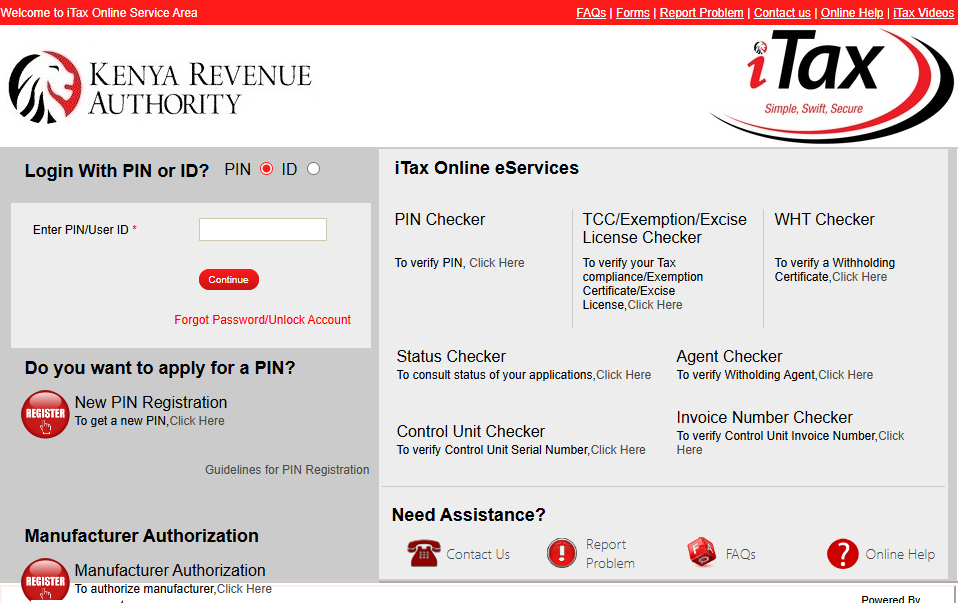
Step 1 — Set Up and Log In to Your iTax Account
Go to itax.kra.go.ke. On the homepage, click “New PIN Registration” if you do not yet have a KRA PIN for your business. If you already have a company KRA PIN, click “Login” and enter your PIN and password.
If this is your first time logging in, use your KRA PIN as the username and the temporary password sent to your registered email. You will be prompted to change your password immediately.
Ensure your iTax account is linked to a valid, active email address and phone number. KRA sends all filing reminders, obligation notifications, and compliance certificates to this contact information.
Step 2 — Confirm Your Tax Obligations
Once logged in, go to the “Obligations” tab on your iTax dashboard. This shows all the taxes your business is registered for and their filing frequencies. Common obligations for a limited company include:
- Income Tax — Company: Filed annually by 30th June
- PAYE: Filed monthly by the 9th of the following month
- VAT: Filed monthly by the 20th of the following month
- Withholding Tax: Filed monthly by the 20th of the following month (if applicable)
- Turnover Tax: Filed and paid quarterly (for businesses with turnover between KES 1,000,000 and KES 25,000,000 that opt into the simplified regime)
If you see obligations listed that do not apply to your business — for example VAT if you are below the threshold — contact KRA to have them deregistered. Unfiled obligations generate automatic penalties even if you have nothing to report.
Step 3 — File PAYE Returns (Monthly)
PAYE is the tax you deduct from your employees’ salaries and remit to KRA on their behalf. It is due by the 9th of every month for the previous month’s payroll.
On iTax, go to “Returns” then “File Return” and select “Income Tax — PAYE.” Download the PAYE return Excel template, fill it in with each employee’s gross salary, allowances, deductions, personal relief, and PAYE amount, and upload the completed file.
After uploading, review the summary, submit the return, and generate a payment slip (E-slip). Pay via MPESA Paybill 572572 or through your bank using the E-slip reference.
If you have no employees in a given month, you must still file a nil return for PAYE to avoid penalties.
Step 4 — File VAT Returns (Monthly)
VAT returns are due by the 20th of every month for the previous month’s transactions. This applies only if your business is VAT-registered.
On iTax, go to “Returns” then “File Return” and select “Value Added Tax.” Download the VAT return Excel template. You will fill in:
- Table 1: Output VAT — all sales made during the month, categorised as standard-rated (16%), zero-rated (0%), or exempt
- Table 2: Input VAT — all purchases made during the month on which VAT was charged
- Net VAT payable: Output VAT minus Input VAT
If your input VAT exceeds your output VAT, you have a VAT credit, which can be carried forward to the next month or applied for as a refund (refund process is separate and can take time).
Since January 2024, KRA has been rolling out the eTIMS (Electronic Tax Invoice Management System) requirement. VAT-registered businesses must issue all invoices through eTIMS, and only eTIMS-validated invoices qualify as legitimate input VAT claims. If your suppliers are not on eTIMS, you cannot claim their VAT as input. Ensure your key suppliers are eTIMS-compliant.
Step 5 — File Withholding Tax Returns (Monthly)
If your business makes payments to suppliers for services, rent, royalties, or dividends, you may be required to withhold tax at source and remit it to KRA. Common withholding tax rates in Kenya include:
- Consultancy and management fees (resident): 5%
- Rent paid to a resident: 10% (30% for non-residents)
- Dividends paid to residents: 5% (15% for non-residents)
- Interest paid to residents: 15%
Withholding tax returns are filed monthly by the 20th of the following month on iTax under “Withholding Tax.” You must issue a withholding tax certificate (available on iTax) to the payee so they can claim it against their own tax liability.
If you did not make any such payments in a month, file a nil return.
Step 6 — File Annual Income Tax Return (Corporate Tax)
This is the most significant annual filing obligation for a limited company. The corporate income tax return covers your full financial year and is due by 30th June each year for businesses whose financial year ends on 31st December.
The current corporate income tax rate in Kenya is 30% of net taxable profit. However, there are important nuances:
- Allowable deductions reduce your taxable income: business expenses, staff costs, depreciation (through capital allowances), interest on business loans, and bad debts written off
- Wear and tear deductions are calculated on a reducing balance basis for machinery, computers, and vehicles
- Investment deductions are available for capital expenditure on industrial buildings and machinery
- Losses can be carried forward for up to 10 years (subject to the provisions of the Income Tax Act)
On iTax, go to “Returns” then “File Return” and select “Income Tax — Company.” The return form is long and detailed. Fill in your income, deductions, capital allowances, tax credits (including installment taxes paid), and arrive at your net tax payable or credit.
Installment Tax: Companies with an annual tax liability above KES 40,000 are required to pay installment taxes in four equal installments during the year — by the 20th of the 4th, 6th, 9th, and 12th months of the financial year. If you do not pay installment taxes, KRA charges a late payment interest of 1% per month on the unpaid amount.
Step 7 — File Nil Returns (When Applicable)
If your business had no transactions in a given period, you are still required to file a nil return for every active obligation. Many business owners miss this. KRA does not distinguish between a business that earned income and did not file and one that had no income but did not file — both are penalised equally.
Filing a nil return on iTax takes less than two minutes. There is no excuse for missing it.
Step 8 — Pay Any Tax Due
After filing each return, iTax generates an E-slip (electronic payment slip) with a unique reference number. Use this reference to make payment via:
- MPESA Paybill 572572 — most common and immediate
- Internet banking — use the E-slip reference as the payment reference
- Bank branch — present the printed E-slip at any KRA-approved bank
Payments must be made by the same deadline as the return. Filing on time but paying late still attracts a late payment penalty of 5% of the tax due plus 1% interest per month on the outstanding amount.
After payment, log back into iTax and confirm that the payment has been receipted against your account. Occasionally MPESA payments take a few hours to reflect — follow up if the payment does not appear within 24 hours.
Step 9 — Download Your Tax Compliance Certificate
Once all your returns are filed and all payments are up to date, you can generate a Tax Compliance Certificate (TCC) from iTax. This certificate confirms that your business has met all its KRA obligations as of the date of issue.
A TCC is required for government tender bidding, bank loan applications, liquor licence renewals, import/export clearing, and many corporate client onboarding processes. It is valid for 12 months and can be verified online by anyone at itax.kra.go.ke using the certificate number.
Go to “Certificates” on your iTax dashboard and click “Apply for Tax Compliance Certificate.” If all your obligations are clear, the certificate is generated instantly.
Full Cost Breakdown: Business Tax Compliance in Kenya (2026)
Government-Mandated Taxes and Rates
- Corporate Income Tax: 30% of net taxable profit (standard rate for resident companies)
- Small business rate: 15% for companies with annual turnover below KES 100,000,000 that have operated for less than 5 years (confirm current applicability with KRA as conditions apply)
- VAT: 16% on standard-rated supplies; 0% on zero-rated (exports, certain basic goods); exempt for specific sectors
- PAYE: Progressive rates from 10% to 35% based on employee salary bands
- Withholding Tax: 5% to 30% depending on payment type and residency of recipient
- Turnover Tax: 3% of gross monthly sales (for businesses with turnover between KES 1,000,000 and KES 25,000,000 that opt in)
Penalties for Non-Compliance
- Late filing penalty (companies): KES 20,000 per return or 5% of tax due, whichever is higher
- Late filing penalty (individuals and sole traders): KES 2,000 per return
- Late payment penalty: 5% of tax due as a one-time penalty
- Late payment interest: 1% per month on outstanding tax until fully paid
- Failure to deduct and remit PAYE: Full PAYE amount becomes the employer’s liability plus penalties and interest
Professional and Compliance Costs
- Accountant for monthly PAYE and VAT filing: KES 3,000 – KES 10,000 per month
- Accountant for annual income tax return preparation: KES 10,000 – KES 50,000 depending on complexity
- Audit fees (where statutory audit is required): KES 30,000 – KES 200,000+ depending on company size
- eTIMS setup and integration (for businesses using accounting software): KES 5,000 – KES 30,000 one-time
- Tax dispute representation (if KRA raises an assessment): KES 20,000 – KES 150,000+
Read also: How to Register a Business Name in Kenya
Common Mistakes to Avoid
1. Confusing your personal KRA PIN with your company KRA PIN. Your business has its own separate KRA PIN obtained after incorporation. Filing business returns under your personal PIN or mixing the two causes serious reconciliation problems that are expensive and time-consuming to fix.
2. Not filing nil returns. Every active obligation must be filed every period — even if there is nothing to report. A single missed nil return generates a penalty of KES 20,000 for companies. Multiply that across 12 months of PAYE, VAT, and withholding tax and the penalties accumulate rapidly.
3. Missing installment tax payments. Many company owners do not know about installment taxes until they file their annual return and find a large interest charge applied. If your annual tax liability is above KES 40,000, you must pay in four installments during the year.
4. Claiming input VAT on non-eTIMS invoices. Since KRA’s eTIMS rollout, only invoices generated through the eTIMS system qualify as valid input VAT claims. If your suppliers are still issuing handwritten or non-eTIMS invoices, you cannot claim that VAT — and attempting to do so triggers a KRA query.
5. Underreporting income. KRA cross-references your declared income against M-Pesa till records, bank statements, eTIMS invoices issued, and customs data for importers. Declaring significantly less income than what these records show triggers an automatic audit. Always declare actual income.
6. Forgetting director benefits and perks in PAYE. Company vehicles, housing allowances, and other benefits provided to directors are taxable as employment income under the PAYE rules. Many businesses omit these, which creates a liability that surfaces during a KRA audit.
7. Waiting for a profit before filing. Many startup owners assume they do not need to file taxes until they make money. This is wrong. PAYE is due when you pay salaries. VAT is due on sales regardless of profit. And the annual income tax return must be filed whether you made a profit or a loss — a loss return establishes your loss carry-forward position which is valuable in future profitable years.
8. Not keeping source documents. KRA requires businesses to retain financial records for at least five years. During an audit, you must produce invoices, receipts, contracts, and bank statements to support your returns. Businesses that cannot produce documentation lose their right to deductions and are assessed on gross income.
Frequently Asked Questions
What is the difference between iTax and eTIMS? iTax is KRA’s main online portal for filing returns, paying taxes, and managing your tax account at itax.kra.go.ke. eTIMS — the Electronic Tax Invoice Management System — is a separate but linked system for generating and transmitting electronic invoices at the point of sale. eTIMS ensures every invoice issued is captured in real time by KRA. VAT-registered businesses must use eTIMS to issue invoices. iTax and eTIMS work together — your eTIMS sales data feeds into your VAT return on iTax.
When exactly are business tax returns due in Kenya? PAYE is due by the 9th of the following month. VAT and withholding tax returns are due by the 20th of the following month. The annual income tax return for companies is due by 30th June for businesses with a 31st December year end. Installment taxes are due on the 20th of the 4th, 6th, 9th, and 12th months of your financial year.
What is the corporate tax rate in Kenya in 2026? The standard corporate income tax rate for resident companies in Kenya is 30% of net taxable profit. Non-resident companies are taxed at 37.5% on income sourced in Kenya. Always confirm with KRA or a tax advisor as rates and reliefs are subject to change through the annual Finance Act.
Do I need to file taxes if my business made no profit? Yes, absolutely. Filing obligations exist regardless of profit or loss. You must file nil returns for any period with no transactions, a loss return for your annual income tax even if you made a loss, and PAYE and VAT returns every month even if they are zero. The only way to stop filing obligations is to formally deregister those obligations on iTax.
How do I get a Tax Compliance Certificate from KRA? Log in to itax.kra.go.ke, go to the “Certificates” tab, and click “Apply for Tax Compliance Certificate.” The system checks that all your returns are filed and all payments are up to date. If there are no outstanding obligations, the certificate is generated immediately. If there are pending issues, you must resolve them before the certificate is issued.
What happens if KRA audits my business? A KRA audit involves KRA officers reviewing your financial records, bank statements, invoices, and contracts for a specific period. You have the right to be notified and to provide documentation. If KRA finds underpaid taxes, they raise a tax assessment. You can pay the assessment, negotiate a settlement, or dispute it through the Tax Appeals Tribunal. Always engage a qualified tax advisor if KRA initiates an audit.
What is Turnover Tax and does it apply to my business? Turnover Tax (TOT) is a simplified tax regime for businesses with annual gross turnover between KES 1,000,000 and KES 25,000,000. It is charged at 3% of gross monthly sales and is filed and paid quarterly. It replaces income tax for eligible businesses that opt in. It is designed for small businesses that find the full income tax regime complex. However, it has limitations — you cannot carry forward losses under TOT. Assess with an accountant whether TOT or the standard income tax regime is more beneficial for your specific business.
Can I amend a tax return already submitted on iTax? Yes. On iTax you can file an amended return by going to “Returns” and selecting “Amended Return” for the relevant obligation and period. You should amend a return if you discover an error after submission — whether it results in additional tax owed or a credit in your favour. Voluntarily correcting errors before KRA discovers them typically reduces penalties compared to corrections made after a KRA inquiry.
Pro Tips from a Kenyan Business Consultant
Hire a competent accountant before you make your first sale. Setting up your tax obligations correctly from day one is significantly cheaper than trying to reconstruct records and fix errors later. A good accountant pays for themselves many times over through legitimate tax planning and penalty avoidance.
Set up a separate bank account just for tax reserves. Every time your business receives income, transfer a fixed percentage into a dedicated savings account — roughly 30% is a conservative estimate for combined PAYE, VAT, and corporate tax. When tax is due, the money is already set aside. This discipline prevents the cash flow crises that lead many businesses to file without paying.
Register for eTIMS immediately, even if you are not yet VAT-registered. KRA is progressively making eTIMS mandatory for all businesses, not just VAT-registered ones. Getting set up early gives you time to train staff, integrate with your accounting software, and iron out technical issues before it becomes a compliance deadline.
Use iTax reminders actively. Log in to your iTax account at the start of each month and check your obligations dashboard. KRA also sends SMS and email reminders — make sure your contact details are current. Set a calendar reminder for the 7th of each month for PAYE and the 18th of each month for VAT to give yourself preparation time.
Never ignore a KRA notice. If KRA sends an assessment notice, a query letter, or an audit notification, respond within the timeframe stated in the notice. Ignoring KRA notices escalates the matter and reduces your options for negotiation. Engage a tax advisor immediately if you receive any formal KRA communication.
Take advantage of allowable deductions legitimately. Many Kenyan business owners either over-claim deductions (risky) or under-claim them (costly). Legitimate deductions include staff costs, rent, utilities, marketing, depreciation, professional fees, and bad debts. Work with your accountant to claim every deduction you are legally entitled to — it is the most straightforward way to reduce your tax bill within the law.
Keep your iTax contact details up to date. KRA uses the email and phone number on your iTax profile for all official communications, including audit notices and compliance alerts. If you change your phone number or email, update your iTax profile immediately. Many businesses miss critical KRA notices simply because contact details were outdated.
Conclusion
Understanding how to file business taxes in Kenya is not just a legal obligation — it is a core business skill. KRA’s systems are more sophisticated than ever, enforcement is stronger, and the penalties for non-compliance accumulate quickly and quietly until they become a serious financial threat.
The good news is that the process, while detailed, is manageable when you approach it systematically. Set up your iTax account correctly, know your obligations and their deadlines, maintain accurate financial records, and file every return on time — even when the figure is zero. These four habits alone will keep the majority of Kenyan businesses out of trouble with KRA.
Work with a qualified accountant, use eTIMS from the start, and never treat tax compliance as something you will deal with later. In Kenya’s current enforcement environment, later almost always costs more than now.
For all official tax matters, visit itax.kra.go.ke and kra.go.ke. For eTIMS registration and support, visit etims.kra.go.ke. When in doubt, consult a Certified Public Accountant registered with the Institute of Certified Public Accountants of Kenya (ICPAK).
Read also:
- How to Register an LLC in Kenya
- How to Register a Business Name in Kenya
- How to Register for VAT in Kenya: A Complete Step-by-Step Guide for Business Owners
- How to Register a Limited Company in Kenya: A Complete Step-by-Step Guide (2026)
