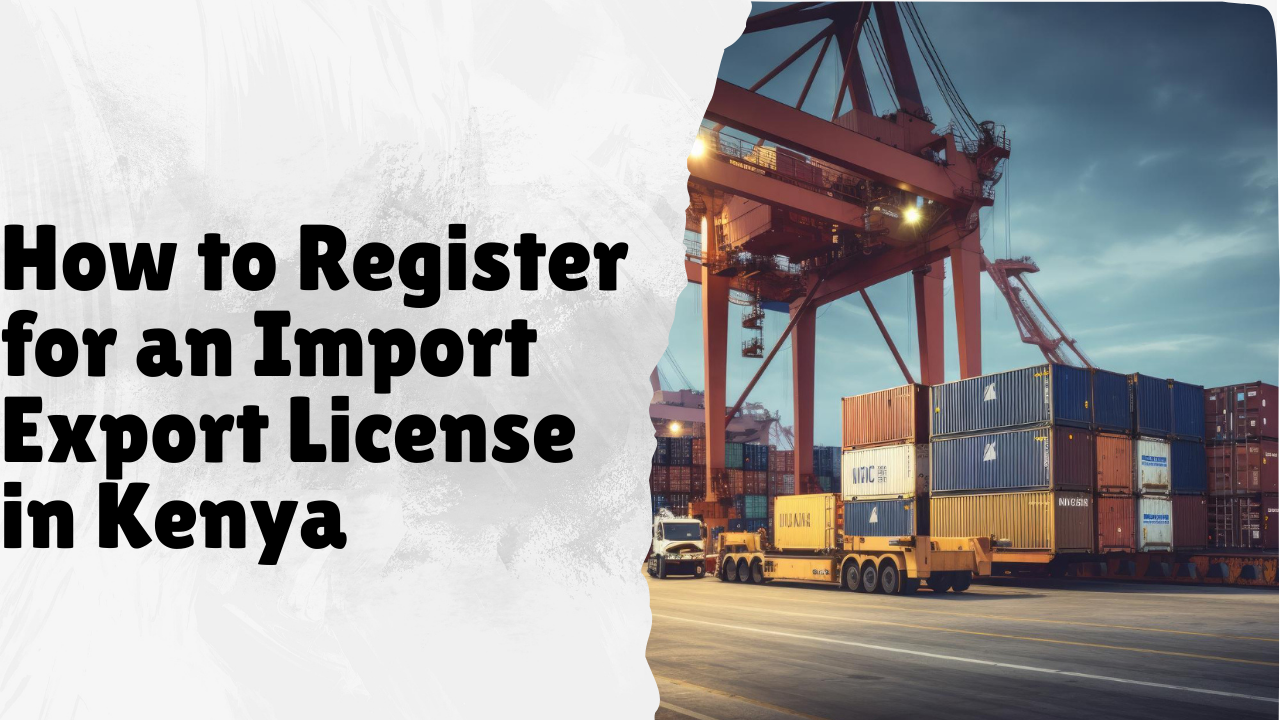
How to Register for an Import Export License in Kenya: A Complete Step-by-Step Guide
 TIMEBUCKS
Low minimum
payout of just
$3 — start
earning today!
Kenya sits at the heart of East Africa’s trade corridor. The Port of Mombasa handles millions of tonnes of cargo every year, the Nairobi Inland Container Depot processes thousands of consignments monthly, and Kenya’s growing middle class creates constant demand for imported goods ranging from electronics to industrial machinery. At the same time, Kenyan exports — tea, coffee, horticulture, manufactured goods, and services — reach markets across the globe every single day.
If you are planning to participate in this trade, understanding how to register for an import export license in Kenya is not optional. It is the legal and operational foundation of every compliant international trade business in the country.

Many Kenyan entrepreneurs are surprised to learn that Kenya does not issue a single blanket “import export license” for all goods. Instead, the framework consists of several registrations, codes, and sector-specific permits that together authorise you to trade internationally. Getting this framework right from the beginning saves you from costly delays at the Port of Mombasa, penalties from Kenya Revenue Authority, and consignment seizures that can cripple a new trading business.
This guide covers the complete registration process for international trade Kenya — including KRA customs registration, obtaining your import code Kenya, understanding export license Kenya requirements, sector-specific permits, and all costs in KES. Whether you are importing electronics from China, exporting fresh produce to Europe, or building a trading business that does both, this is your starting point.
Summary
- What it is: A combination of registrations, codes, and permits that legally authorise a Kenyan business to import and export goods — including KRA customs registration, an Import Declaration Form (IDF) system account, and sector-specific licences where required.
- Who needs it: Any Kenyan individual or business intending to import goods into Kenya or export goods out of Kenya commercially, regardless of business size.
- Main requirements: Registered business with BRS or Companies Registry, business KRA PIN, eCitizen account, Kenya Revenue Authority customs registration, and sector-specific permits depending on goods.
- Estimated cost: KES 5,000 – KES 50,000+ depending on the type of goods, number of permits required, and whether you use a clearing agent.
- Processing time: KRA customs registration — 3 to 7 business days. Sector-specific licences — 14 to 60 days depending on the regulatory body.
- Where to apply: KRA iTax portal (itax.kra.go.ke), Kenya Trade Network Agency — KenTrade portal (kentrade.go.ke), and relevant sector-specific regulatory bodies.
Legal Basis in Kenya
International trade in Kenya is governed by a comprehensive framework of legislation administered by multiple government agencies.
The East African Community Customs Management Act, 2004 (EACCMA) is the primary customs law governing importation and exportation within the East African Community. It establishes customs procedures, tariff obligations, prohibited and restricted goods, and penalties for non-compliance. All imports and exports in Kenya are processed under this Act.

The Kenya Revenue Authority Act, 1995 mandates KRA to administer and enforce customs and excise laws, collect import duty, excise duty, and VAT on imported goods, and regulate the movement of goods across Kenya’s borders.
The Imports, Exports and Essential Supplies Act (Cap 502, Laws of Kenya) gives the government the authority to regulate the importation and exportation of specific categories of goods through licensing and permit requirements.
The Kenya Trade Network Agency (KenTrade) was established under the Kenya Trade Network Agency Order, 2011 to manage the Kenya National Electronic Single Window System (Kenya TradeNet System) — the platform through which all import and export documentation is processed electronically.
Additional legislation governs specific categories of goods — including the Standards Act for goods requiring Kenya Bureau of Standards (KEBS) approval, the Food, Drugs and Chemical Substances Act for pharmaceutical and food imports, and the Wildlife Conservation and Management Act for goods involving animal products.
Regulatory requirements for international trade are complex and frequently updated. Always confirm current requirements with KRA, KenTrade, and relevant sector regulators before conducting any import or export transaction.
Understanding Kenya’s Import Export Framework
Before diving into the registration steps, it is essential to understand how Kenya’s import export system is structured. This clarity prevents costly errors that trap many first-time Kenyan traders.

There is no single “import export licence” in Kenya. What you need is a combination of the following, depending on your goods and business structure:
TIMEBUCKS
Low minimum
payout of just
$3 — start
earning today!
KRA Customs Registration is mandatory for all importers and exporters. It links your business KRA PIN to the KRA customs system, enabling you to file import entries, pay customs duties, and track consignments.
Import Declaration Form (IDF) is an electronic document that must be filed for every consignment imported into Kenya before shipment. It is filed through the Kenya TradeNet System managed by KenTrade.

Export Declaration is the equivalent document required for all exports from Kenya, also filed through the TradeNet System.
Pre-Export Verification of Conformity (PVoC) is a KEBS programme that requires certain imported goods to be inspected and certified in the country of origin before shipment to Kenya. Importers must understand which goods fall under PVoC requirements.
TIMEBUCKS
Low minimum
payout of just
$3 — start
earning today!
Sector-Specific Import and Export Licences apply to regulated categories of goods — pharmaceuticals, food products, agricultural inputs, firearms, hazardous chemicals, wildlife products, and others. Each category has its own regulatory body and licensing process.
Authorised Economic Operator (AEO) Status is an advanced voluntary certification for established importers and exporters that grants expedited customs clearance and other trade facilitation benefits.
Read also: How to Register a SACCO in Kenya: A Complete Step-by-Step Guide (2026)
Requirements Checklist
Prepare all of the following before beginning the registration process.
Business Registration Documents
- Certificate of Business Registration (BRS) or Certificate of Incorporation
- Business KRA PIN certificate
- CR12 for limited companies (directors and shareholders list)
- Valid National IDs for all directors or business owners
- eCitizen account for the lead applicant
For KRA Customs Registration
- Business KRA PIN (mandatory)
- Business name and registration number
- Physical business address including county and sub-county
- Nature of goods to be imported or exported
- HS Codes (Harmonised System Codes) for your goods — these are international product classification codes used for customs purposes
- Bank account details of the business
- Contact details of the designated customs contact person
For KenTrade TradeNet System Registration
- Business KRA PIN
- Valid business email address
- Physical and postal business address
- Category of goods and intended trade volumes
- Clearing agent details (if using a licensed customs clearing agent)
For Sector-Specific Licences (as applicable)
- Documents vary significantly by sector and regulatory body
- Confirm requirements with the specific regulatory authority for your goods category
Read also: How to Apply for AGPO Certificate in Kenya
Step-by-Step Process: How to Register for Import Export License in Kenya
Step 1 — Register and Formalise Your Business
Before any import export registration can proceed, your business must be formally registered in Kenya. You need either a Certificate of Business Registration from BRS for a sole proprietorship or partnership, or a Certificate of Incorporation for a limited company. You must also have an active business KRA PIN obtained through the iTax portal at itax.kra.go.ke.
If you have not yet registered your business or obtained a business KRA PIN, complete those steps first. International trade registration cannot proceed without them. Refer to the earlier guides in this series on business name registration and KRA PIN registration for detailed instructions on both processes.
Step 2 — Identify Your Goods and Determine HS Codes
This step is critical and must be completed before any other trade registration. Every product traded internationally is classified under a Harmonised System (HS) Code — a globally standardised six-to-eight-digit numerical code that identifies the nature of goods for customs, tariff, and regulatory purposes.
Your HS Code determines the import duty rate applicable to your goods, whether your goods require a sector-specific licence or permit, whether PVoC inspection applies to your goods, and any prohibitions or restrictions that may apply.
To find the correct HS Code for your goods, consult the East African Community Common External Tariff (EAC CET) schedule available on the KRA website, use the KRA tariff finder tool on the iTax portal, or engage a licensed customs clearing agent who will classify your goods correctly.
Getting your HS Code wrong is one of the most expensive mistakes in Kenyan trade. It can result in incorrect duty payment, consignment delays, penalties, and even seizure of goods. When in doubt, request a formal tariff classification ruling from KRA before shipping.
Step 3 — Register for KRA Customs on iTax
Log into the KRA iTax portal at itax.kra.go.ke using your business KRA PIN and password. Navigate to the customs registration section and complete the importer or exporter registration form. You will provide your business details, nature of goods, HS Codes, and business address.
Once your KRA customs registration is approved — typically within 3 to 7 business days — your business PIN is activated in the KRA customs system. This activation is what allows you to file Import Declaration Forms, pay customs duties electronically, and track your consignment clearance status online.
You will be assigned a KRA customs registration number that you will reference in all customs-related transactions. Keep this number accessible — it is required every time you process a shipment.
Step 4 — Register on the Kenya TradeNet System (KenTrade)
The Kenya National Electronic Single Window System — known as the Kenya TradeNet System — is the centralised electronic platform through which all import and export documents in Kenya are processed. It is managed by the Kenya Trade Network Agency (KenTrade) and accessible at kentrade.go.ke.
Every importer and exporter must register on the TradeNet System. Registration requires your business KRA PIN, business registration details, contact information, and the category of goods you will be trading. Registration is free for traders.
Once registered, you can file Import Declaration Forms (IDF) for every inbound consignment, submit export documentation for outbound shipments, apply for permits and licences from multiple government agencies through a single platform, track the status of your shipments and regulatory approvals, and make payments for government fees electronically.
The TradeNet System is designed to reduce the time and cost of trade by integrating over 50 government agencies — including KRA, KEBS, KEPHIS, PPB, NEMA, and others — into a single electronic window. Understanding how to use it efficiently is one of the most valuable operational skills for any Kenyan trader.
Step 5 — Obtain Sector-Specific Import or Export Licences
Depending on the nature of your goods, you may need one or more sector-specific licences or permits in addition to your KRA customs registration and TradeNet access. This is where the import export framework in Kenya becomes most complex — and where many first-time traders encounter unexpected delays.
The following are the most common sector-specific requirements for Kenyan importers and exporters. This list is not exhaustive — always confirm the specific requirements for your goods category with the relevant regulatory body.
Kenya Bureau of Standards (KEBS) regulates the quality and safety of imported goods. Many product categories — electronics, building materials, food products, motor vehicles, cosmetics, and others — require KEBS certification before they can clear customs. The Pre-Export Verification of Conformity (PVoC) programme requires these goods to be inspected and certified in the country of export before shipment. KEBS maintains a list of PVoC-regulated goods on its website at kebs.org. Importing PVoC-regulated goods without the required Certificate of Conformity results in the goods being held at the port and subjected to destination inspection, which is significantly more expensive and time-consuming.
Kenya Plant Health Inspectorate Service (KEPHIS) regulates the importation and exportation of plants, plant products, and agricultural inputs. If you are importing seeds, planting material, fresh produce, or agricultural chemicals, or exporting cut flowers, fresh vegetables, or fruits, you must obtain a KEPHIS phytosanitary certificate or import permit. Apply through the KEPHIS portal at kephis.org.
Pharmacy and Poisons Board (PPB) regulates the importation and exportation of pharmaceutical products, medical devices, and related goods. Importing pharmaceuticals without PPB authorisation is a serious criminal offence in Kenya. Apply through the PPB portal at pharmacyboardkenya.org.
Kenya Veterinary Board and the Directorate of Veterinary Services regulate the importation and exportation of live animals, animal products, and veterinary medicines. An import permit and veterinary health certificate are required for all regulated animal products.
National Environment Management Authority (NEMA) regulates the importation of environmentally sensitive goods including certain chemicals, hazardous waste, and ozone-depleting substances. Some goods require a NEMA import licence before they can be cleared through customs.
Agriculture and Food Authority (AFA) regulates the exportation of key Kenyan agricultural products including tea, coffee, sugar, horticulture, and pyrethrum. Exporters of these commodities must be registered with the relevant commodity directorate under AFA.
Capital Markets Authority (CMA) approval may be required for certain financial service exports or cross-border financial transactions, depending on the nature of the service.
Step 6 — Engage a Licensed Customs Clearing Agent
For most Kenyan importers and exporters — particularly those who are new to international trade — engaging a licensed customs clearing agent is not just convenient, it is practically essential. A licensed clearing agent is a professional registered with KRA to handle customs documentation, duty payment, and cargo clearance on behalf of importers and exporters.
Your clearing agent will prepare and file your Import Declaration Forms on TradeNet, calculate and facilitate customs duty payment, coordinate with port authorities at the Port of Mombasa or Nairobi ICD, liaise with sector regulators for permit compliance, and arrange physical clearance and delivery of your goods.
Clearing agent fees typically range from KES 15,000 to KES 60,000 per consignment, depending on the size, nature, and complexity of the shipment. These costs must be factored into your landed cost calculations.
To verify that a clearing agent is licensed, confirm their registration with KRA’s list of licensed customs agents. Engaging an unlicensed agent is a serious compliance risk — you remain fully legally responsible for any customs violations that occur during your consignment clearance.
Step 7 — File Your Import Declaration Form (IDF) for Each Consignment
Once registered on TradeNet and KRA customs, you must file an Import Declaration Form (IDF) for every consignment you import into Kenya before the goods are shipped from the country of origin. The IDF must be filed at least 7 days before shipment for most goods.
The IDF captures details of the importer, the exporter, the goods (including HS Codes, quantities, and values), the country of origin, the port of entry, and the mode of transport. Your clearing agent will typically prepare and file the IDF on your behalf.
An IDF filing fee of 0.6% of the customs value of the goods (CIF value) is charged by KenTrade, subject to a minimum fee. This fee is paid electronically through the TradeNet System.
After filing the IDF, you will receive an IDF reference number that your supplier must reference on the shipping documents. The IDF is linked to your consignment throughout the customs clearance process.
Step 8 — Pay Customs Duties and Facilitate Clearance
When your goods arrive at the Port of Mombasa, Jomo Kenyatta International Airport, or other points of entry, your clearing agent will lodge a customs entry on the KRA system and calculate the applicable duties. Duties payable may include import duty (rates vary by HS Code and country of origin under applicable trade agreements), excise duty (for excisable goods), VAT on imported goods (16% on the customs value plus duty), Railway Development Levy (RDL) of 1.5% of CIF value, and Import Declaration Fee (IDF) of 3.5% of CIF value.
Pay customs duties electronically through the KRA customs payment gateway. Once duties are paid and the entry is processed, KRA releases the goods for physical examination (if selected for inspection) or direct clearance. Your clearing agent coordinates the physical removal of goods from the port and their delivery to your premises.
Step 9 — Comply With Export Documentation Requirements
If you are exporting goods from Kenya, the process mirrors importation in several respects but has its own documentation requirements. For every export consignment you must file an export declaration on the TradeNet System, obtain the applicable export permits or certificates (phytosanitary certificates from KEPHIS for agricultural products, AFA export certificates for regulated commodities, certificates of origin for preferential tariff treatment in destination markets), comply with any export restrictions or prohibitions on your goods, and ensure your goods meet the standards required by the destination country.
Kenya has several active trade agreements that provide preferential market access for Kenyan exports — including the African Continental Free Trade Area (AfCFTA), the EAC Common Market Protocol, the COMESA Trade Framework, and bilateral agreements with specific countries. Certificates of origin are required to claim preferential tariff rates under these agreements and are issued by the Kenya National Chamber of Commerce and Industry (KNCCI) or KRA depending on the agreement.
Total Cost Breakdown in Kenya
International trade compliance involves multiple layers of cost. Here is a transparent breakdown of what Kenyan importers and exporters should budget for.
Registration Costs (One-Off)
- Business registration (BRS): KES 850 – KES 1,000
- Business KRA PIN: Free
- KRA customs registration: Free
- KenTrade TradeNet System registration: Free
- CR12 for companies: KES 650
Per-Consignment Import Costs
- Import Declaration Fee (IDF): 3.5% of CIF value
- Railway Development Levy (RDL): 1.5% of CIF value
- KenTrade IDF filing fee: 0.6% of CIF value (minimum fee applies)
- Import duty: 0% to 35% of CIF value (varies by HS Code and country of origin)
- Excise duty: Varies by goods category
- VAT on imports: 16% of (CIF value + import duty + excise duty)
- Destination inspection fee (if applicable): Varies
- Port charges, handling, and storage: Varies by consignment size and duration
Clearing Agent Fees
- Customs clearing and forwarding per consignment: KES 15,000 – KES 60,000
- Port handling coordination fee: KES 5,000 – KES 20,000
Sector-Specific Licence and Permit Fees
- KEBS PVoC Certificate of Conformity: USD 250 – USD 500+ (charged in USD by overseas inspection bodies)
- KEPHIS import/export permit: KES 1,000 – KES 10,000 depending on goods
- PPB pharmaceutical import permit: KES 5,000 – KES 50,000 depending on product
- NEMA import licence: KES 5,000 – KES 30,000
- Certificate of Origin: KES 1,000 – KES 3,000 per certificate
Annual Compliance Costs
- Licence renewals (sector-specific): Varies
- KRA tax compliance (income tax, VAT returns): Accountant fees KES 5,000 – KES 30,000 per year
All costs are indicative and subject to revision. Government levies and duty rates change with each annual Finance Act. Always confirm current rates with KRA and relevant regulatory bodies before budgeting for a shipment.
Common Mistakes to Avoid
1. Starting the importation process before completing KRA customs registration. Attempting to clear goods through customs without an active KRA customs registration leads to consignment holds, port storage charges, and potential penalties. Complete your registration before placing your first order with an overseas supplier.
2. Getting the HS Code wrong. Incorrect HS Code classification is one of the costliest mistakes in Kenyan trade. It leads to wrong duty calculation, compliance failures with sector-specific regulations, and potential fraud allegations from KRA. Always verify your HS Code before filing an IDF.
3. Ignoring PVoC requirements until goods arrive in Kenya. Discovering that your goods require a KEBS Certificate of Conformity only after they have arrived at Mombasa Port results in expensive destination inspection, extended port storage charges, and potential rejection of the goods. Research PVoC requirements before placing your order.
4. Using an unlicensed clearing agent. Unlicensed agents cannot legally file customs entries, and any errors or compliance failures they cause remain the legal responsibility of the importer. Always verify your agent’s KRA licence before engaging them.
5. Undervaluing goods on customs declarations. Declaring a lower customs value to reduce duty payable is customs fraud under the EACCMA and the Kenya Revenue Authority Act. KRA customs officers are experienced at identifying undervaluation and the consequences — penalties, seizure, and criminal prosecution — are severe and irreversible.
6. Failing to file the IDF before shipment. The IDF must be filed before goods are shipped from the country of origin, not after arrival in Kenya. Filing after arrival results in a late IDF penalty and customs entry delays that accumulate expensive port storage charges.
7. Not accounting for all import costs in your pricing. Many first-time Kenyan importers calculate their landed cost based on the supplier’s invoice price alone, forgetting to include IDF fees, RDL, import duty, VAT, clearing fees, port charges, and inland transport. The result is a landed cost far higher than anticipated, destroying the profitability of the trade. Always calculate the full landed cost — including all duties, levies, and clearing fees — before committing to a purchase order.
8. Neglecting export documentation requirements. Kenyan exporters often focus entirely on production and logistics while neglecting the documentation their foreign buyers and destination customs authorities require — certificates of origin, phytosanitary certificates, health certificates, and quality certificates. Missing documentation causes shipment rejections at the destination, financial penalties, and loss of overseas clients.
Frequently Asked Questions
Do I need a specific import export licence to trade internationally in Kenya?
Kenya does not issue a single blanket import export licence. What you need is a combination of registrations — primarily KRA customs registration and KenTrade TradeNet System access — plus sector-specific permits depending on the nature of your goods. Some goods such as pharmaceuticals, agricultural products, chemicals, and wildlife products require additional licences from sector regulators like PPB, KEPHIS, or NEMA. The specific requirements depend entirely on what you are importing or exporting.
How much does it cost to import goods into Kenya?
The total cost of importing into Kenya depends on the nature and value of your goods. Key costs include the Import Declaration Fee of 3.5% of CIF value, Railway Development Levy of 1.5% of CIF value, import duty ranging from 0% to 35% depending on the HS Code and country of origin, VAT at 16% of the duty-inclusive value, and clearing agent fees of KES 15,000 to KES 60,000. For a consignment with a CIF value of KES 1 million and a 25% duty rate, total government levies alone can exceed KES 600,000 before clearing agent fees.
What is the Kenya TradeNet System and why do I need it?
The Kenya TradeNet System is the national electronic single window platform managed by KenTrade through which all import and export documentation in Kenya is processed. It integrates over 50 government agencies into one platform, allowing traders to file Import Declaration Forms, apply for sector-specific permits, pay government fees, and track consignment status — all in one place. Every importer and exporter in Kenya must register and operate through this system.
What goods are prohibited from importation into Kenya?
Kenya maintains a list of prohibited imports under the EACCMA and sector-specific legislation. Absolutely prohibited goods include narcotic drugs and psychotropic substances, counterfeit currency and goods, pornographic material, goods that infringe intellectual property rights, certain hazardous chemicals and pesticides, and goods from countries under international trade sanctions. Additionally, some goods are restricted rather than prohibited — meaning they can be imported only with the appropriate licence or permit. Always check the current prohibited and restricted goods list with KRA before sourcing goods overseas.
Do I need a clearing agent to import into Kenya?
You are not legally required to use a clearing agent — you can clear your own goods directly. However, the customs clearance process in Kenya involves complex documentation, technical HS Code classification, electronic filing on multiple government platforms, and physical port coordination that is extremely difficult for a first-time importer to navigate independently. For most businesses, especially those new to international trade Kenya, engaging a licensed clearing agent is strongly recommended. As your experience and import volumes grow, you may consider training an in-house customs compliance officer.
What is PVoC and which goods does it apply to in Kenya?
Pre-Export Verification of Conformity (PVoC) is a KEBS programme that requires certain imported goods to be inspected and certified in the country of origin before shipment to Kenya. It applies to a wide range of product categories including electronics and electrical equipment, building and construction materials, motor vehicles and spare parts, food and food products, cosmetics and personal care products, and many others. KEBS appoints accredited inspection agencies in various countries to conduct PVoC inspections and issue Certificates of Conformity. Importing PVoC-regulated goods without a valid Certificate results in compulsory and expensive destination inspection in Kenya.
How do I benefit from Kenya’s trade agreements when exporting?
Kenya has preferential trade agreements that allow Kenyan exports to access partner markets at reduced or zero tariff rates. To benefit, your goods must meet the applicable rules of origin requirements and you must obtain a valid Certificate of Origin. Certificates of Origin for different agreements are issued by either KNCCI or KRA depending on the specific agreement. Engaging a trade facilitation specialist or your clearing agent to advise on the applicable agreement and documentation requirements for your specific export market is strongly recommended.
What penalties apply for customs non-compliance in Kenya?
Penalties for customs non-compliance in Kenya are severe. They include financial penalties of up to four times the value of the goods for undervaluation or misdeclaration, seizure and forfeiture of goods, cancellation of import or export privileges, criminal prosecution of the importer or exporter and their directors, and blacklisting from the KRA customs system. KRA customs officers conduct regular audits of importer and exporter records, and post-clearance audits can go back several years. Maintaining accurate, complete, and compliant trade records from your first consignment is not just good practice — it is essential for your business survival.
Pro Tips from a Kenyan Business Consultant
Calculate your full landed cost before placing any import order. The single most important financial discipline for a Kenyan importer is knowing your true landed cost — the total cost of getting goods from an overseas supplier to your warehouse in Kenya. This includes the supplier price, international freight, marine insurance, IDF fees, RDL, import duty, VAT, clearing agent fees, port charges, and inland transport. Build a landed cost calculator in Excel before you start trading and update it every time government levies change.
Build a relationship with a reliable, licensed clearing agent before you need one. Do not search for a clearing agent when your first consignment is already at the port. Interview two or three licensed agents, check their KRA registration, ask for client references, and establish a working relationship before you place your first overseas order. A good clearing agent is one of the most valuable business relationships a Kenyan importer can have.
Stay updated on Finance Act changes every June. Kenya’s National Assembly passes a Finance Act every year that typically amends import duty rates, introduces or removes tax exemptions, and adjusts various levies. Changes take effect on 1st July each year. A duty rate change on your key goods can dramatically affect your cost structure and profitability. Subscribe to KRA’s updates and review the Finance Act every year with your clearing agent or tax advisor.
Register for VAT before you start importing commercially. If your import business will have annual turnover exceeding KES 5 million, register for VAT before your first commercial importation. As a VAT-registered importer, you can claim input VAT credit on the VAT paid at customs — reducing your effective tax cost significantly. Importing without VAT registration when you should be registered creates a retroactive VAT liability with penalties.
Invest in understanding the EAC Common External Tariff. The EAC Common External Tariff determines the duty rates applicable to goods imported into Kenya from outside the EAC. Understanding how to read the tariff schedule — including duty rates, applicable exemptions, and goods under the EAC duty remission schemes — gives you a competitive advantage in sourcing and pricing decisions. Many Kenyan traders pay more duty than necessary because they are unaware of applicable exemptions or remissions.
Explore the Export Processing Zones (EPZ) and Special Economic Zones (SEZ) incentives. If you are building a significant export-oriented manufacturing business, Kenya’s EPZ and SEZ frameworks offer substantial tax and duty incentives — including exemption from import duty on raw materials and capital goods used in export production. The Kenya Export Processing Zones Authority (KEPZA) and the Special Economic Zones Authority (SEZA) administer these programmes. Engage a qualified advisor to assess whether your business model qualifies.
Conclusion
Understanding how to register for an import export license in Kenya is the gateway to one of the most dynamic and potentially lucrative sectors of the Kenyan economy. International trade offers Kenyan entrepreneurs access to global markets, competitive sourcing opportunities, and the chance to build businesses of real scale.
But the opportunity comes with complexity. Kenya’s trade regulatory framework — spanning KRA customs registration, the KenTrade TradeNet System, KEBS standards compliance, sector-specific licensing, and ongoing duty and levy obligations — demands discipline, preparation, and ongoing attention.
The entrepreneurs who thrive in Kenyan international trade are not necessarily those with the biggest capital. They are the ones who understand the rules, build the right professional relationships, calculate their costs accurately, and stay consistently compliant. Get your registrations right, know your HS Codes, engage a trusted clearing agent, and treat every consignment as a compliance exercise as much as a commercial one.
Kenya’s position as East Africa’s trade hub is only growing. Register correctly, comply consistently, and position your business to benefit from the enormous trade opportunities that flow through this country every day.
Read also:
- How to Apply for AGPO Certificate in Kenya
- How to Copyright Your Business Work in Kenya
- How to Apply for a Business Loan in Kenya
- How to Write a Business Plan in Kenya
TIMEBUCKS
Low minimum
payout of just
$3 — start
earning today!