Remotasks Kenya: How to Get Paid Training AI Models Online in 2026
 TIMEBUCKS
Low minimum
payout of just
$3 — start
earning today!
The rise of artificial intelligence has created thousands of remote work opportunities worldwide, including in Kenya. One platform gaining attention is Remotasks Kenya, where people earn money by completing AI training tasks from home. Whether you’re a student, stay-at-home parent, or someone looking for flexible side income, AI training jobs offer a genuine way to make money online without needing advanced technical skills.
In this comprehensive guide, we’ll explore everything about Remotasks: what it is, how it works, whether it’s legitimate, how much you can earn, and how to get started—even if you’re a complete beginner.

What Is Remotasks?
Remotasks is an online platform operated by Scale AI, a leading artificial intelligence company based in San Francisco. The platform connects remote workers (called “Taskers”) with companies that need human input to train and improve AI systems.
When you work on Remotasks, you’re helping teach AI models to recognize patterns, understand language, label images, and make better decisions. Your work contributes to the development of self-driving cars, virtual assistants, medical AI, and other cutting-edge technologies.
Remotasks operates globally, meaning anyone with internet access and the right skills can sign up and start earning. The platform offers thousands of micro-tasks daily, ranging from simple image labeling to more complex text annotation and AI response evaluation.
Is Remotasks Legit or a Scam?
Remotasks is a legitimate platform, not a scam. It’s owned by Scale AI, a well-funded company that works with major tech firms like OpenAI, Microsoft, and Toyota. Thousands of people worldwide have been paid for their work on the platform since it launched.

However, legitimacy doesn’t mean guaranteed income. Here’s what you need to understand:
Why Remotasks is legitimate:
- Backed by a reputable parent company (Scale AI)
- Has a transparent payment system
- Provides real training and skill development
- Offers customer support for workers
- Pays workers regularly via PayPal and other methods
Important realities to consider:
- Task availability varies greatly depending on your location, skills, and time zone
- You must pass qualification tests to access higher-paying tasks
- Your account can be suspended if you submit low-quality work
- Income is inconsistent and depends on task availability
- Some workers report long waiting periods between tasks
The platform is real and pays real money, but it’s not a “get rich quick” scheme. Success requires patience, attention to detail, and consistent effort to build your skills and reputation.
How Does Remotasks Work?
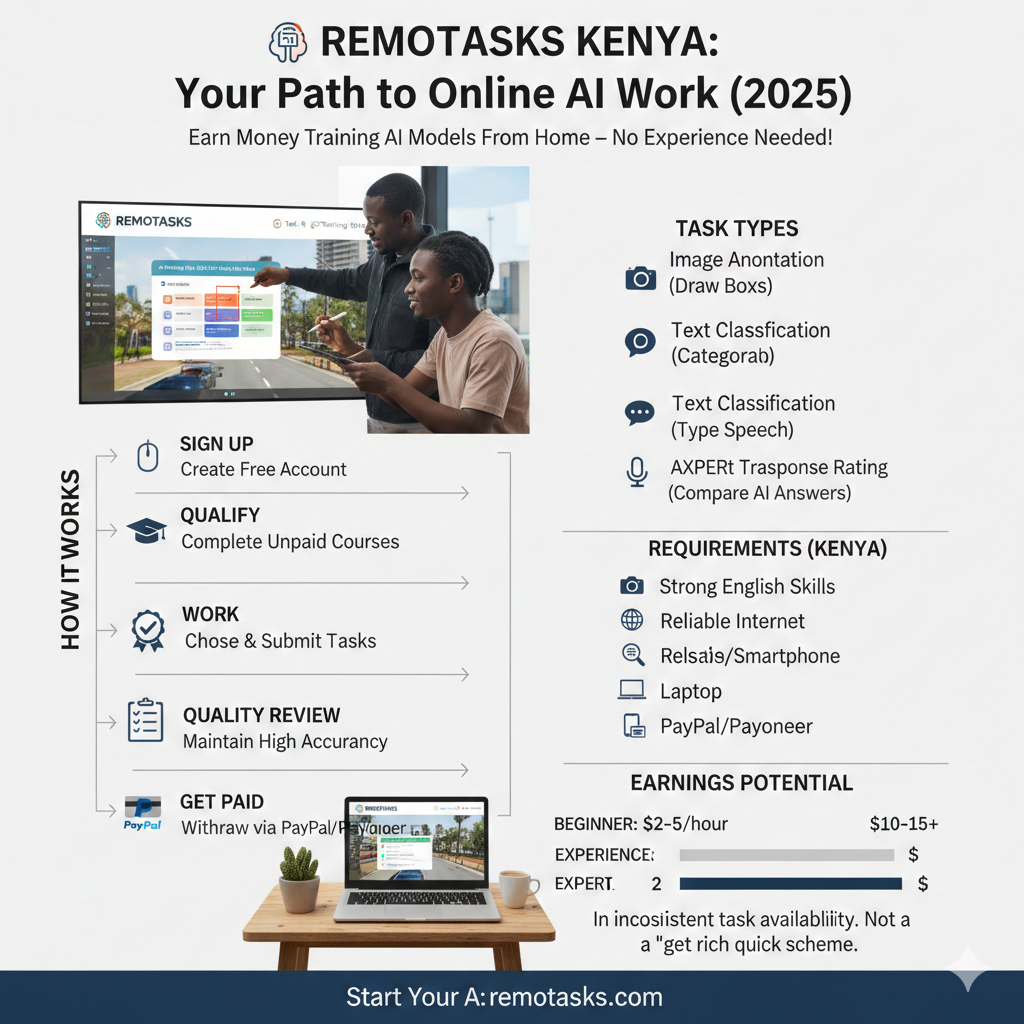
Remotasks operates on a task-based system where you complete specific assignments and get paid per task. Here’s the step-by-step process:
Step 1: Sign Up Create a free account on the Remotasks website. You’ll need to provide basic information including your email address, name, and payment details.
Step 2: Complete Training Before you can start earning, you must complete training courses for different task types. These courses teach you how to complete tasks correctly and meet quality standards. Training is unpaid but essential for unlocking earning opportunities.
TIMEBUCKS
Low minimum
payout of just
$3 — start
earning today!
Step 3: Pass Qualification Tests After training, you’ll take assessments to prove you understand the task requirements. Passing these tests unlocks access to real paying tasks. Some tests are easier than others, and you can retake failed tests after a waiting period.
Step 4: Choose and Complete Tasks Once qualified, you’ll see available tasks in your dashboard. Tasks are assigned on a first-come, first-served basis, so active users get more opportunities. You select a task, follow the instructions carefully, and submit your work.
Step 5: Quality Review Your submitted work goes through quality checks. High-quality work increases your reputation score and unlocks better-paying tasks. Poor-quality work can lead to account warnings or suspension.
Step 6: Get Paid Earnings accumulate in your account and can be withdrawn once you reach the minimum payout threshold (usually $5 to $20 depending on your payment method).
TIMEBUCKS
Low minimum
payout of just
$3 — start
earning today!
What Is an AI Trainer or Data Labeler?
An AI trainer, also called a data labeler or annotator, is someone who helps teach artificial intelligence systems by providing human judgment and feedback. Think of it as being a tutor for robots—you’re helping AI learn to understand the world the way humans do.
Common tasks include:
Image Annotation: Drawing boxes around objects in photos (cars, people, traffic signs) to help self-driving car AI recognize them. For example, you might label thousands of images showing pedestrians crossing streets.
Text Classification: Reading text and categorizing it by topic, sentiment, or intent. You might label customer reviews as positive, negative, or neutral.
Audio Transcription: Listening to voice recordings and typing out what was said, helping voice assistants understand different accents and speech patterns.
AI Response Rating: Comparing two AI-generated answers and choosing which one is better, more accurate, or more helpful. This improves chatbots and virtual assistants.
Data Verification: Checking if information is correct, relevant, or appropriate. For example, verifying that a business address matches its location on a map.
Comparison Tasks: Looking at two similar items and identifying differences or determining which one better matches specific criteria.
You don’t need to understand how AI algorithms work—you just need good judgment, attention to detail, and the ability to follow instructions carefully.
Can You Join Remotasks From Kenya?
Yes, Remotasks accepts workers from Kenya and many other countries worldwide. However, availability varies, and not all task types are available in all regions.
Requirements to join from Kenya:
Strong English Skills: Most tasks require good English reading and writing ability since instructions and content are primarily in English.
Reliable Internet Connection: You need stable internet to load tasks, watch training videos, and submit work without interruption.
Computer or Smartphone: While some tasks can be done on mobile devices, a laptop or desktop computer provides better access to higher-paying tasks that require more complex work.
Attention to Detail: Success depends on your ability to follow instructions precisely and maintain high accuracy in your work.
Time and Patience: Building a sustainable income takes time. You’ll need to invest hours in training and gradually work your way up to better-paying task categories.
Payment Method: You’ll need a PayPal account or other supported payment method to receive your earnings. Some payment options may have restrictions based on your country.
Kenyan workers have successfully used Remotasks to earn supplementary income, though experiences vary based on individual dedication, skill development, and task availability in the region.
How Much Does Remotasks Pay?
Remotasks payment varies significantly based on task type, complexity, your skill level, and your location. There’s no fixed hourly rate or guaranteed income.
Payment structure:
Per-Task Payment: Most tasks pay between $0.01 and $5.00 per completed task. Simple tasks (like clicking on an image) pay very little, while complex tasks (like detailed 3D annotation) pay more.
Effective Hourly Rate: Experienced workers report earning anywhere from $2 to $15 per hour, depending on task availability and their speed. Beginners typically earn on the lower end while learning.
Skill-Based Progression: As you complete more tasks successfully and pass advanced training, you unlock higher-paying task categories. Top performers with specialized skills can earn more than average users.
Factors affecting your earnings:
- Your location: Some regions have more task availability than others
- Time of day: Peak hours in certain time zones may have more tasks available
- Your accuracy rate: High-quality work unlocks better opportunities
- Speed and efficiency: Faster completion means more tasks per hour
- Task complexity: More difficult tasks pay more but require more training
Important reality check: Many users report inconsistent earnings, with some weeks offering plenty of work and others having very few tasks available. Remotasks should be considered supplementary income rather than a full-time salary replacement, especially when starting out.
Payment Methods and Payment Frequency
Remotasks offers several payment options to accommodate workers worldwide, though availability depends on your country.
Common payment methods:
PayPal: The most widely used option, available in most countries including Kenya. Payments are processed quickly, usually within a few days of withdrawal requests.
Payoneer: An alternative for users who don’t have access to PayPal or prefer this payment platform.
Airtm: Available for workers in certain regions, providing another digital wallet option.
Bank Transfer: Direct bank deposits may be available in select countries, though this option is less common.
Payment frequency and process:
Minimum Withdrawal: You must reach a minimum threshold before requesting payment, typically between $5 and $20 depending on your payment method.
Payment Schedule: Remotasks processes payments on a rolling basis. Once you request a withdrawal (after meeting the minimum threshold), payments are typically processed within 3-5 business days.
No Automatic Payments: You must manually request withdrawals from your dashboard when you’re ready to cash out.
Processing Time: After requesting payment, expect 3-7 days for the money to appear in your account, depending on your payment provider.
Payment Fees: Some payment methods charge transaction fees. PayPal, for example, may deduct a small percentage or flat fee depending on your country and transaction amount.
Always keep your payment information up to date in your account settings to avoid delays when cashing out your earnings.
Do You Need Experience or AI Skills to Join Remotasks?
No, you don’t need prior experience or advanced AI knowledge to start with Remotasks. The platform is designed for beginners and provides comprehensive training.
What you DO need:
Basic Computer Skills: Ability to navigate websites, follow online instructions, and use basic tools like clicking, typing, and uploading files.
Reading Comprehension: You must understand written English instructions and follow them precisely.
Attention to Detail: Success depends on accuracy. Small mistakes can impact your quality score and task availability.
Patience and Persistence: The learning curve can be steep, and building meaningful income takes time.
Willingness to Learn: You’ll need to invest time in unpaid training and practice to qualify for paying tasks.
What you DON’T need:
- A college degree or formal education in AI or computer science
- Programming or coding knowledge
- Previous remote work experience
- Expensive software or specialized equipment
Helpful skills that improve your success:
- Good visual perception (for image tasks)
- Strong language skills (for text tasks)
- Fast typing speed (for transcription tasks)
- Critical thinking (for evaluation tasks)
- Time management (for maximizing earnings)
Remotasks is genuinely beginner-friendly, but “beginner-friendly” doesn’t mean “effortlessly profitable.” You’ll need to dedicate time to learning, practice regularly, and gradually build your skills to access better-paying opportunities.
Step-by-Step: How to Apply for Remotasks
Getting started with Remotasks is straightforward. Follow these steps to create your account and begin your AI training journey.
Step 1: Visit the Remotasks Website Go to remotasks.com and click on the “Sign Up” or “Get Started” button. You can also download the Remotasks app if you prefer working from your smartphone.
Step 2: Create Your Account Enter your email address and create a strong password. You may also have the option to sign up using your Google or Facebook account for faster registration.
Step 3: Complete Your Profile Provide basic information including your full name and location. Make sure all details are accurate as this information will be used for payment processing.
Step 4: Set Up Your Payment Method Connect your PayPal, Payoneer, or other supported payment account. Verify your payment details to ensure you can receive earnings without issues.
Step 5: Browse Available Training Courses Explore the training dashboard to see available task categories. Start with beginner-friendly courses like image annotation or basic categorization.
Step 6: Complete Training Modules Watch tutorial videos and read instructions carefully. Take notes if needed. Training is unpaid but essential for qualification.
Step 7: Pass the Qualification Tests After each training module, you’ll take an assessment. You must score above the minimum threshold (usually 70-80% accuracy) to unlock paying tasks in that category.
Step 8: Start With Simple Tasks Begin with basic tasks to build your reputation score. Focus on accuracy over speed initially—quality matters more than quantity when you’re starting out.
Step 9: Track Your Performance Monitor your quality score in your dashboard. If it drops, review your mistakes and retake training if necessary.
Step 10: Gradually Advance As you gain experience, attempt training for more complex, higher-paying task categories. Consistent high-quality work opens doors to better opportunities.
Tips for success:
- Read all instructions twice before starting any task
- Don’t rush through training just to start earning—understanding the requirements prevents costly mistakes
- Join Remotasks community forums or Discord channels to learn from experienced workers
- Work during peak hours when more tasks are available
- If you fail a qualification test, wait the required period and try again with better preparation
Pros and Cons of Remotasks
Like any remote work platform, Remotasks has advantages and disadvantages. Here’s an honest assessment to help you decide if it’s right for you.
Advantages:
Legitimate Platform: Backed by Scale AI, a reputable company with real clients and verifiable payments.
No Upfront Costs: Free to join with no hidden fees or required purchases.
Flexible Schedule: Work whenever you want, as much or as little as your schedule allows.
Learn Valuable Skills: Gain experience in AI training, data annotation, and quality assessment—skills increasingly valuable in the job market.
Global Availability: Accessible from Kenya and many other countries worldwide.
Multiple Task Types: Variety keeps work interesting and lets you specialize in areas matching your strengths.
Remote Work: Work from home, a café, or anywhere with internet connection.
No Experience Required: Genuinely beginner-friendly with comprehensive training provided.
Disadvantages:
Inconsistent Task Availability: Some days have plenty of work; other days have almost none, making income unpredictable.
Low Pay for Beginners: Starting pay is often very low until you build skills and unlock better task categories.
Unpaid Training Time: You must invest hours learning before earning anything, which can be discouraging.
Strict Quality Standards: Low accuracy can lead to account warnings, suspension, or permanent bans.
Payment Delays: Some users report waiting longer than expected for payments during peak withdrawal periods.
Limited Customer Support: Getting help with account issues can be slow or difficult.
Competition for Tasks: Popular tasks get claimed quickly, especially during peak hours.
Repetitive Work: Some tasks can be monotonous and mentally draining over long periods.
No Benefits: As an independent contractor, you don’t receive health insurance, paid leave, or other employment benefits.
Requires Self-Motivation: Without a boss or fixed schedule, staying productive requires discipline.
Remotasks vs Other AI Training Sites
Remotasks isn’t the only platform offering AI training jobs. Here’s how it compares to similar opportunities:
Remotasks vs Outlier AI: Outlier AI typically pays higher rates (often $15-30 per hour) but has stricter qualification requirements and focuses more on specialized tasks requiring domain expertise. Remotasks has lower pay but easier entry for beginners.
Remotasks vs Appen: Appen offers more stable, project-based work with regular hours, but qualification processes can be lengthy. Remotasks provides quicker access to tasks but less consistent availability.
Remotasks vs Lionbridge: Lionbridge tends to offer longer-term projects with more predictable income. Remotasks offers more flexibility but less income stability.
Remotasks vs Amazon MTurk: MTurk has more task variety and constant availability but often pays even less than Remotasks. Remotasks has better training and higher-paying specialized tasks.
Remotasks vs DataAnnotation: Both platforms are similar in structure and pay rates. DataAnnotation may have different task availability depending on your location and skills.
Best approach: Many successful AI trainers work on multiple platforms simultaneously to maximize earning opportunities and reduce the impact of low task availability on any single site.
Frequently Asked Questions (People Also Ask)
What is Remotasks?
Remotasks is an online platform where people earn money by completing AI training tasks like image labeling, data annotation, and content evaluation. It’s operated by Scale AI and connects remote workers with companies developing artificial intelligence systems.
Is Remotasks available in Kenya?
Yes, Remotasks accepts workers from Kenya and many other countries worldwide. You’ll need strong English skills, reliable internet, and a PayPal or other supported payment method to receive earnings.
How does Remotasks pay?
Remotasks pays per completed task, with earnings varying from a few cents to several dollars depending on task complexity. Payments are processed through PayPal, Payoneer, or other methods, typically within 3-5 business days after withdrawal requests.
Can you get paid to train AI without experience?
Yes, Remotasks and similar platforms accept complete beginners. You’ll need to complete unpaid training courses and pass qualification tests, but no prior AI knowledge or technical degree is required to start earning.
Is Remotasks safe and legit?
Remotasks is a legitimate platform owned by Scale AI, a reputable company. It’s not a scam and does pay workers for completed tasks. However, income is inconsistent and depends on task availability, your skills, and quality of work.
How long does Remotasks approval take?
Account approval is usually immediate after registration. However, accessing paying tasks requires completing training modules and passing qualification tests, which can take several hours to several days depending on the task category and your learning pace.
Conclusion
Remotasks Kenya offers a genuine opportunity to earn money online by helping train artificial intelligence systems. It’s a legitimate platform backed by a reputable company, requiring no upfront investment or advanced technical skills.
However, success requires realistic expectations. This isn’t a get-rich-quick scheme or a replacement for full-time employment. Instead, think of Remotasks as a flexible side income source that rewards patience, attention to detail, and consistent effort.
Remotasks is best suited for:
- Students looking for flexible part-time income
- Stay-at-home parents seeking work-around family schedules
- Remote workers wanting to supplement their main income
- Beginners interested in learning about AI and data annotation
- Anyone with spare time and good internet connection
You should look elsewhere if:
- You need immediate, substantial income to meet essential expenses
- You lack patience for unpaid training and gradual skill building
- You’re not comfortable with income inconsistency
- You struggle with attention to detail or following precise instructions
If you decide to try Remotasks, approach it with patience and commitment to learning. Start with simple tasks, focus on quality over quantity, and gradually build your skills to unlock better-paying opportunities. Consider working on multiple AI training platforms to maximize your earning potential and reduce dependency on any single source.
Ready to get started? Visit remotasks.com to create your free account and begin your journey in AI training work. Remember: success comes from consistent effort, continuous learning, and maintaining high-quality standards in everything you submit.
TIMEBUCKS
Low minimum
payout of just
$3 — start
earning today!